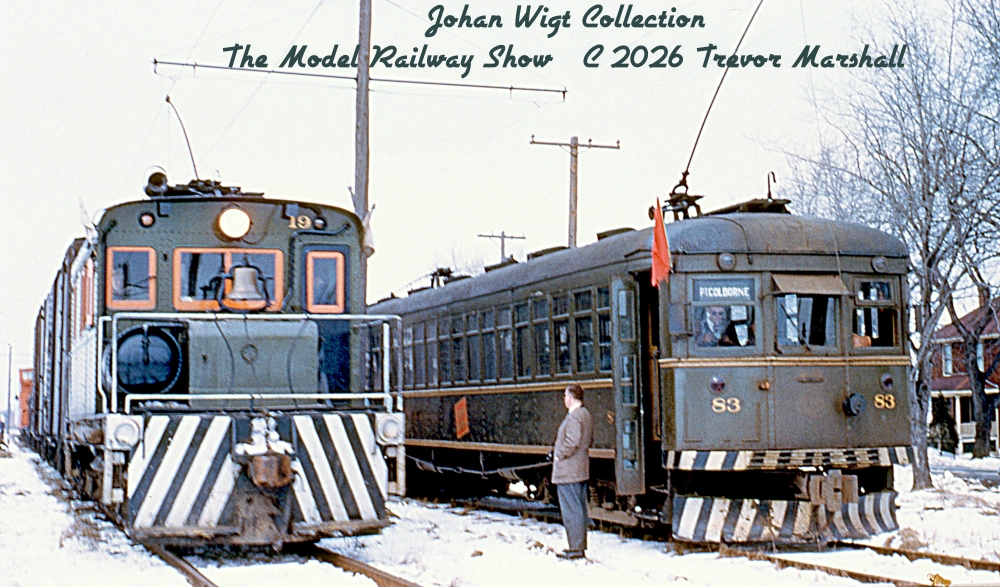
I recently watched a presentation by John Golden about the Southern Iowa Railway – and it got me thinking about the Railroad Prototype Modellers movement and prototypes that ran under wire.
I’ll start by admitting a bias: As regular readers know, I’m trying to bring an S scale interpretation of the Niagara St. Catharines & Toronto Railway to life in my layout space. And I’ll admit that hasn’t been easy – but no more difficult than creating a recognizable model of any specific prototype railway. So why aren’t more traction subjects being tackled? I’m not talking about pure streetcar/transit systems, but full-service interurbans that offered city and intercity passenger services, freight switching, express (package) services, and so on.
I’m generalizing here, and there are exceptions. But compared to a steam road, everything about traction tended to be smaller scale. Passenger trains were typically a single self-propelled car (or perhaps two or three coaches). They didn’t need special turning facilities, made many stops within modest distances, and ran much more frequently. The freight focus was less about bridge line operations and more about the last mile – shuffling freight cars between online customers and interchanges with one or more steam roads. Here too, service could be frequent and freight motors did not need turning facilities.
The practical aspects of squeezing a representation of such a railway into a layout space are definitely helped by prototypically shorter trains and shorter mainlines, as well as sharper curves, tighter turnouts, and railroad facilities that tended to be both simpler and smaller.
When I discuss this with others, a few issues are commonly raised.
The first is the age of the prototypes.
It’s true, North America’s full-service traction lines are long-gone and/or people don’t remember them. (The most famous survivor, the Iowa Traction Company, is now a freight-only line and an excellent candidate for a layout.) This is also true of steam-era railroading – and lots of people model that.
As with modelling a steam road, traction modelling requires research. The good news is, depending on one’s chosen prototype, there are some good resources. I have several shelves filled with books on traction lines from across North America.
Certain lines are extensively documented – for example, the Pacific Electric, Illinois Traction/Illinois Terminal, the many Iowa interurbans, and Canadian lines (including my favourite, the NS&T). I belong to several online groups for prototype traction enthusiasts, and each is filled with photos and stories. So – depending on subject – it’s relatively easy to get started.
A second issue is the availability of traction-specific equipment.
A surprising amount of equipment was imported for certain roads by companies such as Suydam. While much of this was road-specific (the Pacific Electric is a good example), there are also several examples of generic equipment – for example, GE steeple cabs and Baldwin Westinghouse freight motors, which are the traction equivalent of the EMD SW9, ALCO S2, or a USRA 0-6-0.
These older models likely need some love to be improved to today’s standards. But as my friend Steve Lee showed in the February 2026 issue of Railroad Model Craftsman magazine, it can be done. His work on Pacific Electric box motors is exquisite and brings these old models into the 21st Century in every sense.
It should be noted that availability of accurate motive power is a challenge for many prototype modellers of steam railroads, too. Steam locomotives were often unique: Compare locomotives of the same wheel arrangement from different railroads and it’s obvious. For example, CNR, CPR, and Boston & Maine 4-6-2s look nothing alike.
For many steam enthusiasts, building a prototype roster means means hunting for older brass imports, then remotoring and upgrading them to modern standards. That’s certainly the case here in Canada, where it’s quite common to find layouts built around re-motored and DCC-equipped Canadian steam imported decades ago by Van Hobbies (a Canadian version of Pacific Fast Mail).
I would argue that it’s much easier to upgrade a freight motor than a steam locomotive – from a modelling perspective, traction equipment is basically a diesel mechanism with a trolley pole or a pantograph on top.
Beyond older models, traction enthusiasts are benefitting from the same advances in 3D printing that other aspects of the hobby are enjoying. A 3D printed shell, some aftermarket details, and some modern power trucks – controlled by DCC decoders – opens up many exciting possibilities.
A third issue is the overhead wire. Many people otherwise interested in traction modelling seem to suffer from anxiety over the overhead.
Perhaps what’s needed is a system (parts, fixtures, tools, and clear instructions including how-to videos) for building overhead – much like Fast Tracks developed a system for hand-laid track. Before Fast Tracks, hand-laid track was an art practised by a minority. Today, many people are able to hand-lay reliable track with no concerns. Would such a system for overhead make a difference? Are we waiting for Fast Traction?
There is another approach. I was worried about the overhead for my NS&T project – until some early experiments with overhead proved to me that I hated putting a cat’s cradle of wires over the models I needed to couple/uncouple, and track I needed to maintain.
My solution was simply to do away with it: Model the poles, and string some EZ Line to represent some cross spans, and let the imagination fill in the rest. It works surprisingly well.
As I said off the top, I’m biased. I have a connection to traction railroading in general and the NS&T in particular. Beyond the emotional attachment, I believe there are many practical advantages from a layout design and operations perspective.
I also recognize there are hurdles – some serious, some perceived. But those have not prevented enthusiasts of the steam era from building layouts (including many huge examples) that recognizably model a specific prototype, place, and era – so I don’t think they should be impediments to building a traction empire, either.
The best part is, there are many, many excellent prototypes ripe for modelling – representing all regions of North America. If you’re looking for something a little different yet still rewarding, maybe it’s worth exploring the possibilities. You may even find one you like that once ran in your own community.

