Bydemill in RMC

That’s not something you see every day…

One of the things I enjoy most about Bydemill – my 7mm scale interpretation of an Edwardian era, Great Western Railway branch line terminal – is how it forced me to explore ideas, techniques, and resources that were new to me.

As I’ve noted on this site, many of those have now found application in the parts of my hobby with which I have more experience. For example, building the many photo-etched kits for GWR wagons that fill out my goods trains helped me hone the skills required to build the freight motors that form the core of my S scale version of the Niagara St. Catharines & Toronto Railway.

Bydemill has also given me a much-needed change of focus when I experience setbacks on projects for other interests. Bydemill is closer to “finished” than any other layout I’ve built, and it’s a consistently reliable runner – so when my enthusiasm for the hobby wanes, I can always rely upon my British layout to remind me why I have enjoyed railway modelling for more than five decades.


Knowing that other hobbyists may also benefit from moving out of their comfort zone, I used these thoughts as the basis for a brief feature in the October, 2026 issue of Railroad Model Craftsman magazine. RMC focusses on North American subjects and readers who are not open-minded will probably be annoyed to see a British layout grace its pages – but I also know those people account for just a minority of RMC’s readership.

I hope the article will inspire the rest of consider exploring a scale, gauge, prototype, era, or theme that’s outside their comfort zone – whether via one or two mantlepiece models or, as I have, through a secondary layout.


I kept the article short, but submitted many more photos than space allowed, to provide editor Otto Vondrak with some choice as the laid out the feature. Here are the images that did not make the cut. Thank you, Otto, for continuing to share my work with your readers.

A GWR “Siphon” – a specialized wagon designed to transport milk churns in passenger trains – awaits loading at Bydemill.
Coal was a huge commodity for railways in the UK, and the private owner wagons used to transport it added colour and variety to trains. Here, a couple of wagons spotted at the far end of the goods yard await unloading by the local coal merchant.
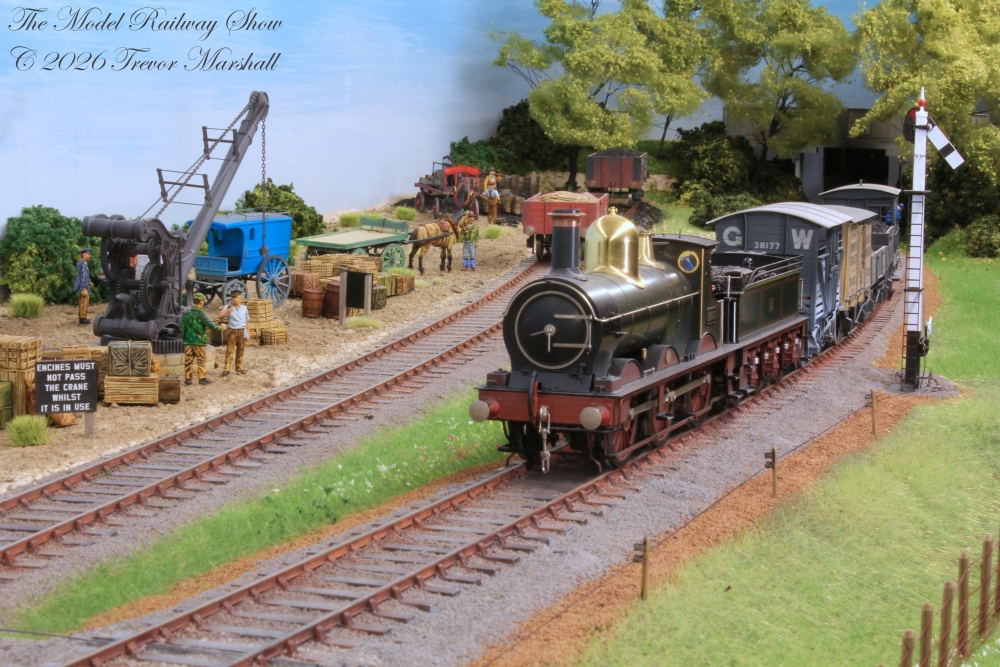
With the starter signal showing green, a short goods train prepares to leave Bydemill for Swindon.

NS&T 17 award follow-up

The award from the National Association of S Gaugers (NASG) for my article on building a freight motor in brass was a bigger deal than I thought. A few days after I received the certificate, a courier left a box on the front porch. Inside was a lovely plaque recognizing my contribution to promoting S scale to the broader railway modelling community:

“It’s a major award!”

I mention this not to brag (although I am proud of the model, and pleased my work has been recognized) but to encourage others working in S scale to share their passion with those who do not model in 1:64.

S is not for everyone. But those who like it, like it a lot and it’s a shame more hobbyists don’t explore it – perhaps by tackling a mantlepiece model or small diorama. And as my experience demonstrates, the effort is appreciated.

NS&T 17 publication award

This S scale freight motor is already my all-time favourite construction project…

This week’s mail included a pleasant surprise: An award from the National Association of S Gaugers (NASG) – recognizing my feature in Railroad Model Craftsman magazine about building Niagara St. Catharines & Toronto Railway freight motor 17.

The NASG is a class act, and creating awards like this can only encourage hobbyists to share their love of 1:64 modelling with the wider world.

Those who enjoy building in niche scale/gauge/prototype combinations often end up talking in an echo chamber filled with like-minded modellers. What’s more, one of the frequent topics is, “How to we attract more hobbyists to our favourite combo?”

This award is a good example of what can be done. It’s specifically designed to recognize modellers who have written an article about S scale for a non-S scale publication. What a great way to expose others to what can be done in 1:64.


Thank you to everyone at the NASG who was involved in this. I’m grateful for the recognition: It means a lot.

I’m also grateful to Otto and the team at RMC for being open to running features about niche combinations: If you have an idea for an article, I encourage you to get in touch with RMC to get it published.


If you missed the article on NS&T 17, you can find it in the May 2025 issue of RMC. And you can follow this link to learn more about my interest in the Niagara St. Catharines & Toronto Railway.

15 years of Port Rowan

My calendar app reminded me that on this day in August, 2011, I embarked on what would be my most successful layout-building project.

A short freight leaves St. Williams, bound for Port Rowan.

That layout was Port Rowan in 1:64 – an S scale interpretation of a CNR branch line in its final years.

On paper, the layout was simple: It filled an odd-shaped space roughly 14 by 35 feet, but featured just two towns (plus staging) and a grand total of eight turnouts. The layout supported one train at a time operation, with enough work to keep a two-person crew entertained for an hour or so. It’s the very definition of what I came to call an Achievable Layout.

But there was a lot more to Port Rowan than that description suggests.


I have hovered around the prototype modelling sphere for decades and have built (well, started) a number of prototype-based layouts. But Port Rowan marked the first time I had built a layout that looked like a model of a railway, rather than a model railway. By exercising restraint during track planning, I ended up with plenty of room to present the railway in context with its surroundings.

I loved that about it.

In a scene that would never have happened on the prototype, two trains meet at Port Rowan. Note how scenery dominates the scene: I loved how I was able to present the railway as part of a larger world.

Port Rowan’s appearance encouraged me to put the railway in context operationally, too. I embraced what I call “finescale operations”, with prototypically-designed paperwork, a working telegraph system, turnouts controlled by switch stands, and other features. It was very satisfying.


As I reflect on what made it such a success – for me, anyway – I’m considering what lessons from Port Rowan I can apply to my current layouts. Overall, I’m pleased with GWR Bydemill and CNR Pine Street. But I think some improvements are in order for my main layout – based on the Niagara St. Catharines & Toronto Railway.

The NS&T is the project that is closest to my heart, and as a consequence it’s the subject on which I have placed the greatest demands. As I look at it today, I realize the layout I’m building is not measuring up. Changes are in order, and Port Rowan provides me with important insights into what those should be.

Separating subways

Railroad Model Craftsman magazine recently published my Test Track review of Rapido Trains’ Toronto Transit Commission “Gloucester” subway cars, I mentioned that separating the permanently-coupled pairs is easier if one uses tweezers to squeeze the shank at one end of the drawbar. (I call it a drawbar because that’s how it functions, even though it looks like a pair of couplers.) This is also useful if one wants to remove a coupler from either end of a two-car set.

I realized a photo might help, so here it is:

As the image shows, the couplers have a split shank with prongs. These slide through the draft gear box then snap open at the back of the box, locking the coupler in place. There’s just enough room to slide fine tweezers between the truck and the draft gear, to squeeze the pronged ends while pulling the coupler (or drawbar) out from the front.