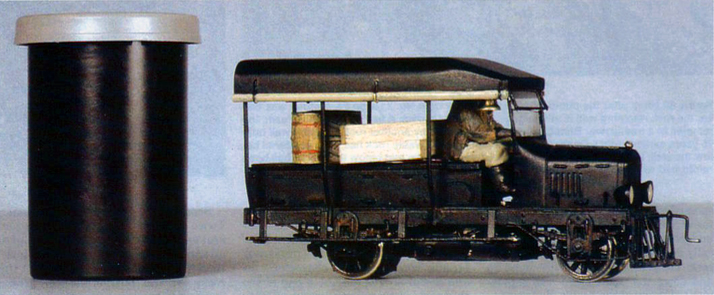
Today, we take for granted that – unless a model is microscopic – the manufacturer will offer it equipped with DCC and sound. It’s easy to forget that even a few years ago, modellers had to be a lot more creative when figuring out how to jam electronics into tiny spaces.
This O scale, two-foot-gauge railcar was probably my most challenging DCC installation. The now-defunct Train and Trooper hobby shop specialized in Maine two-foot gauge models and imported this On2 model of the Sandy River & Rangley Lakes inspection car back in the early 2000s. As the lead photo shows, the model is not much bigger than a film canister. (Remember those?) Since I had a DCC-equipped Maine On2 layout at the time, I wanted to fit a decoder – and, better yet, a sound-equipped one. Could I do it?
My solution was to put a speaker inside some crates on the bench seat, and tuck the decoder – a Soundtraxx LC 090 with Galloping Goose sound file – into the roof. The six wires from the decoder to track, motor, and speaker passed through the driver figure, which was a resin figure I found at a military modelling shop … and drilled from head to bum. (Ouch!)
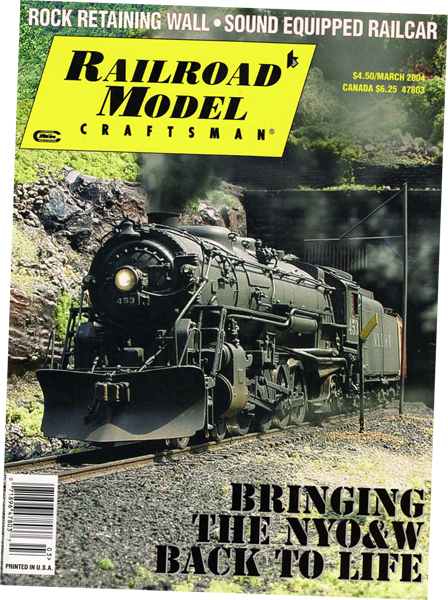
I wrote about this project in the March, 2004 issue of Railroad Model Craftsman magazine.
Today, this installation would be a lot easier.
The Soundtraxx LC 090 was a small sound decoder at the time, but huge compared to today’s micro and nano decoders. Modern decoders have much better motor control, and the space saved compared to the LC 090 could be used to add a stay-alive – which would further enhance the performance of this small, light model. Meantime, sugar cube speakers would produce better sound than the 3/8″ round speaker I used.
I think I’ve talked myself into an upgrade.
 The Model Railway Show