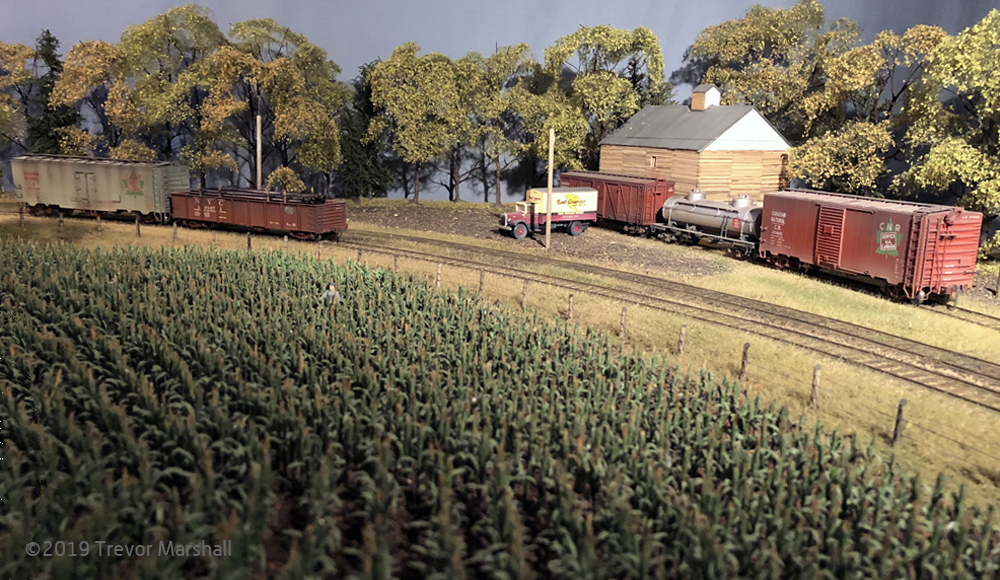
I decided early in the planning stages for my Port Rowan layout that I would enhance the train-running experience by using paperwork inspired by the prototype. Therefore, instead of car cards and rows of pigeon-hole boxes on the layout fascia to help operators sort them, I would create waybills and provide my crews with paper, pencils and small clipboards so that conductors could use the waybills to write up their own switch lists.
In theory, the bills stay safe and dry in the caboose, while the brakeman does the work referring to notes on a hand-written list – a list that can blow away in the wind, fall into the ditch, or otherwise be destroyed without affecting the railroad’s ability to be paid for its effort.
My friend Chris Abbott built me some prototype-inspired bill boxes for the layout fascia – one each for St. Williams and Port Rowan. Before he could do that, I needed to create the waybills themselves: We needed to know how big these documents would be. I went searching for ideas on the Internet – and here I have to give a shout-out to Tony Thompson for his extensive work on waybills and other railroad paperwork. If you really want to get a handle on freight car forwarding, the “Waybills” postings on Tony’s blog are a great place to start.
Using this information, I created a blank Waybill that’s 4.5″ wide by 5.5″ tall – much smaller than a real Waybill, so it would be easier to handle a stack of them. I also created a blank Empty Car Bill measuring 2.25″ wide by 5.5″ tall. I duplicated these then saved the masters where I wouldn’t accidentally use them.
To create a new Waybill or Empty Car Bill, I pull a copy of the appropriate blank into PhotoShop and type in the required data using American Typewriter 10pt. I pick a blue colour for this data – it looks like typewriter ribbon and unlike black ink, the blue helps the information pop off the paperwork. This makes it easier for visiting operators – most of whom don’t do this every day for a living – to find the information they need. (I learned this trick from Tony’s blog, by the way.)
I did not fill in all the information on the paperwork. But at a minimum, I add the following data: Road name at top and bottom of waybil; Car initials and number; Car kind (AAR code); Destination – including the “TO” (track name, spot number), “STATION” and “STATE”; Route (which wasn’t really needed on the Port Rowan layout, since the rest of the world was represented by a single staging location); and Consignee (Name and Town). All of this information is on the left side of the Waybill.
For loads originating on the branch, I filled in the Shipper’s information on the right side as well, including: Origin – including the “FROM” (track name, spot number), “STATION” and “STATE”; and Shipper (Name and Town).
There are two types of Empty Car – both using the same Empty Car Bill.
The first type is an empty car that is being delivered to a shipper on the branch for loading. For these, I fill out an Empty Car Bill with car number, type, and then the information in the “FOR LOADING” section.
The second type is a car that has been emptied by a receiver on the branch and is headed for home. For these, I fill out an Empty Car bill with car number, type, and then the information in the “FOR HOME” section. I then staple this to the front of an appropriately completed Waybill.
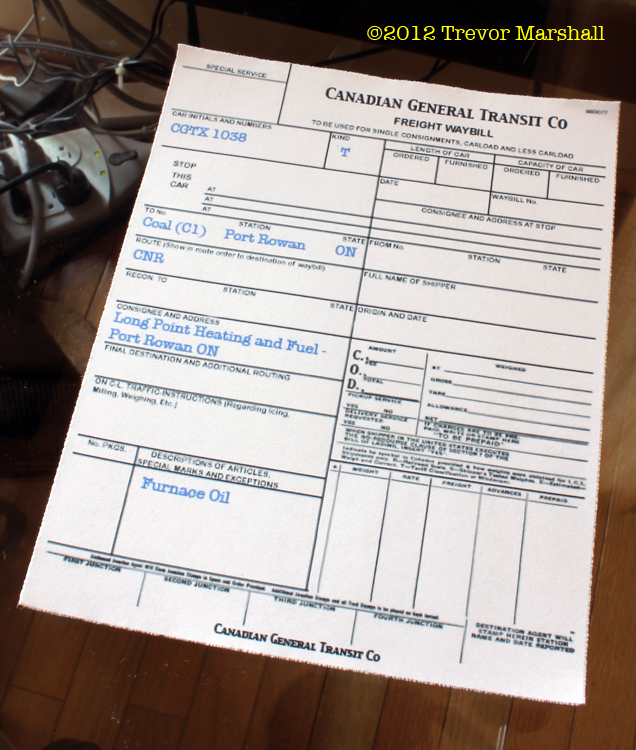
A loaded car coming onto the layout requires a Waybill to direct the crew where to spot it. For example, I have created a Waybill for tank car CGTX 1038 that directs it to the elevated coal track in Port Rowan, for unloading by the local fuel dealer. I will include this Waybill in the package of paperwork for the train crew:
But I will actually print two of the Waybills, then fill out an Empty Car Bill FOR HOME (Canadian Petroleum Co. in Sarnia ON) and attach it to the front of the second copy:
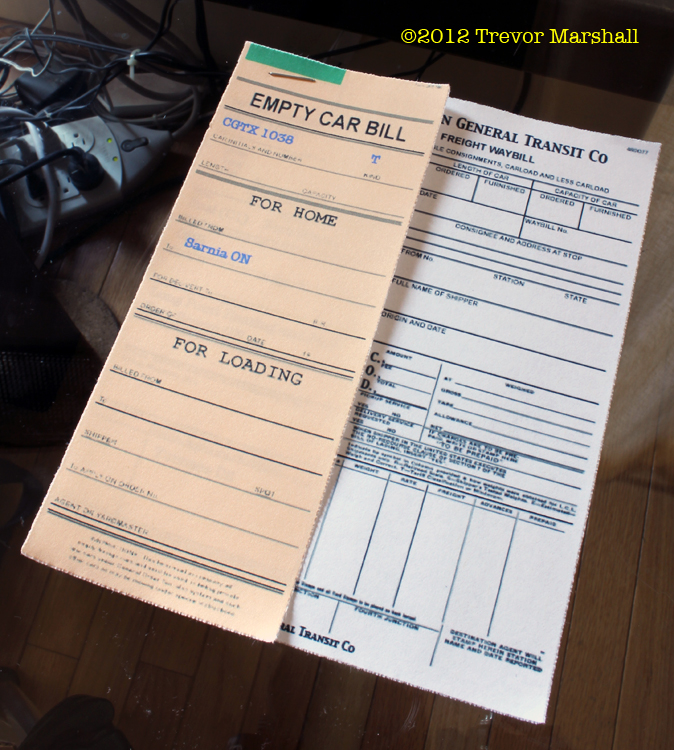
In some future session, when I decide it’s time for this tank car to return to the refinery (staging), I will load the “Waybill/Empty Car Bill” set into the bill box in front of the Port Rowan station. When the crew arrives, they will check the bill box take this paperwork with them when they leave town with CGTX 1038 in their consist.
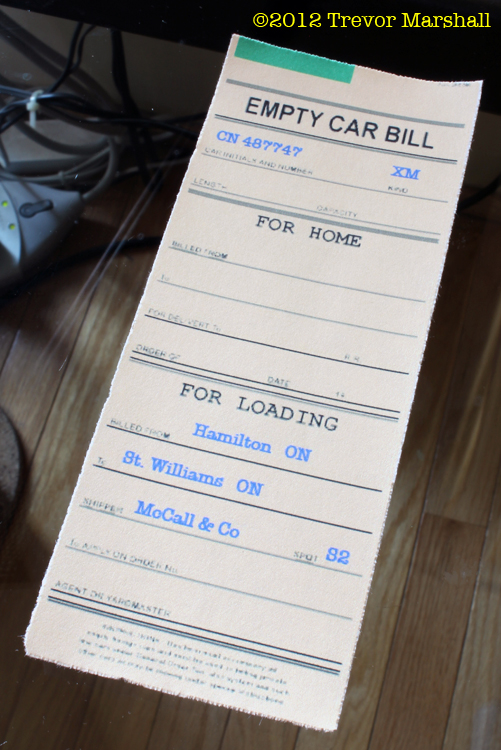
An empty car coming onto the layout for loading requires an Empty Car Bill filled out FOR LOADING. For example, I might direct empty boxcar CN 487747 to the team track in St. Williams for McCall and Company by adding this Empty Car Bill to the crew’s paperwork:
At the same time, I will also create a Waybill for the loaded car – in this case, filled with boats being shipped to Eaton’s in Toronto:
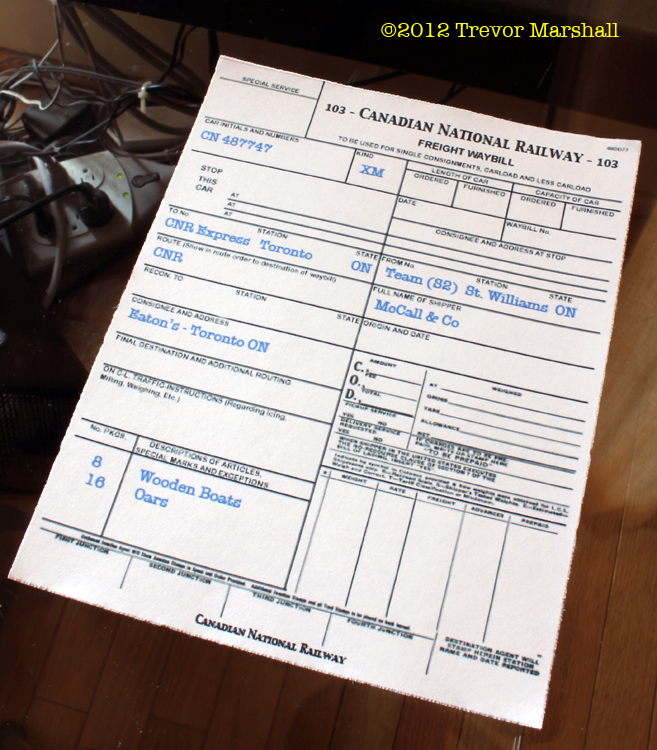
When it’s time for this car to be lifted, I will put the Waybill in the St. Williams bill box.
Some cars will require only one on-layout destination. As an example, I have a flat car wtih a tractor load. Its only plausible destination is the team track in Port Rowan, where Potter Motors will unload the shipment.
For most cars, though, I will create sets of Waybills and Empty Car Bills to allow the car to go to two or three places on the layout: For example, a boxcar might deliver lumber to the St. Williams team track in one session. In another session, that same car might deliver feed additives to the mill in Port Rowan. And in a third session, it might be used to ship a load of boats from McCall and Company in St. Williams to Eaton’s in Toronto. This adds variety to the moves, so that crews don’t see, for example, a Milwaukee Road boxcar and assume they know where it’s going.
This system worked really well for visiting crews for the eight years or so that it was in use. I’ll use a version of this again on future layouts.
(This is an update of a 2012 post from my previous blog about Port Rowan.)
 The Model Railway Show