
When setting up for an operating session on my last model railway (Port Rowan in 1:64), I’d start by building what I call the Conductor’s Package. This is the set of paperwork and other information that conductors need to safely navigate their trains over the line. In this case, I’ll share the contents for a freight extra behind 2-6-0 Number 80.
First, I’d include a copy of the Employee Time Table:

This document contains a schedule of trains, notes, and special instructions adapted from the prototype time table. It also includes useful tips to help conductors and engineers do their work on the layout.
I frequently had to make up some of these before a session, since I started giving them away to visiting operators as a keepsake. It also allowed interested operators to study the Employee Time Table in more detail at their leisure.
Next, I provided a Clearance Form and a Train Order:


These two documents authorize the crew of Engine 80 to occupy the railway. The Clearance Form includes a list of initial Train Orders – in this case, one order (Number 5). The Train Order gives the crew authority to run as an extra from Hamilton to Simcoe, and back to Hamilton. Since Port Rowan and Port Dover are both part of the Yard Limits south of Simcoe, authority is not needed to run to these two terminals – so it’s not given here.
I created the Clearance and Train Order forms for my friend Pierre Oliver, by redrawing official CNR documents. Pierre then took my artwork to a local printer, which printed up pads for us to use.
For those who wanted to use my working telegraph system, the package also included a cheat sheet:

This is greatly simplified International Morse Code, which allows the conductor (putting on the agent/operator’s hat) to OS his train with the dispatcher when arriving and leaving St. Williams and Port Rowan. The information for the return trip – in this case, Extra 80 East – is printed on the reverse side.
Finally, I added the waybills and a blank switch list for any freight cars to be delivered:
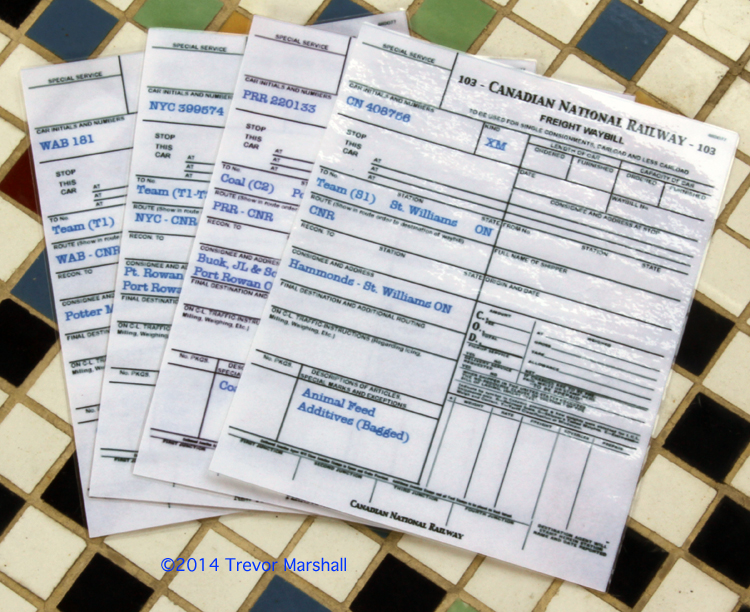

The waybills are presented in the same order that the cars appear in the train.
I secured everything, in the order presented here, to a small clipboard that represents the conductor’s desk in the caboose. This can be seen in the lead photo for this post.
In addition to this package, the conductor required a pen and an uncoupling tool. With that, they were ready to roll!
(This is an update of a 2014 post from my previous blog about Port Rowan.)
 The Model Railway Show