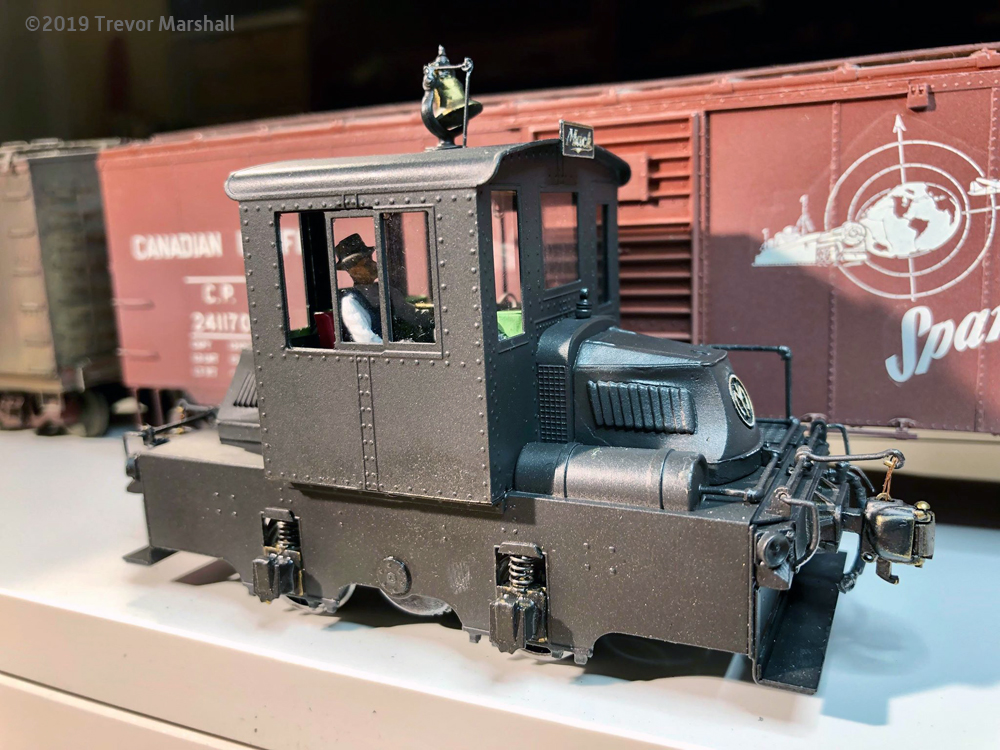
I like oddball stuff on flanged wheels, so it should come as no surprise that I jumped at the chance to grab this O scale Mack switcher when it showed up on the market many years ago.
The prototype is Mack’s first locomotive, which rolled out of the factory in Pennsylvania in May of 1921. It’s a 33 Ton model with a 40 HP gas engine mounted under each hood and a chain drive. It was used to sort freight cars in and around the company’s plant.
Lee Snover Jr. offered this brass model under the Lee Town Models brand. Mine is Number 52 of 54. Even in 1:48, this is a tiny model – less than 4.5″ over the footboards. Despite its diminutive stature, the model has a can motor between the frames and runs beautifully, while the brass construction gives it plenty of weight.
The model sat in lifetime brass for several years until I decided it was time to tackle the project. By then, I decided I wanted to convert it to Proto:48 and after a conversation with Jay Criswell at Right-O-Way, I ordered a set of 30″ wheels for it. My friend Ryan Mendell, who knows way more than I do about how to use a lathe, offered to help me turn the model’s axles to accept the new wheels at the slightly narrower, prototypically-correct gauge. It was a great lesson in planning such work.
I really wanted to add DCC and sound to this model, so I planned that installation, added pickup wipers, and cut holes for wire runs before heading to the paint shop. The model has plenty of room belowdecks for a Loksound Micro decoder and a stay-alive module, while a pair of sugar cube speakers sit in the cab below the window line. Open windows let the sound out.
To paint this model, I started by taking it apart and giving it a wash. The bell had gone missing, so I ordered a replacement and mounted the bracket to the roof – but left off the bell itself until I was done painting. I masked the mechanism – all located below the frame – and shot Tamiya Surface Primer followed by a coat of Dark Iron. This is a colour I love: It has a whole lot going on in it, and it really brings out details.
I used an emery board to carefully remove the paint from the “MACK” sign on the cab roof and from the emblems on each hood. A top coat of Alclad II flat protected the finish.
Meantime, I painted the interior with a “locomotive cab green” (can’t remember what, exactly, anymore) and brush-painted the details in various colours. I found a suitable driver, painted him up, and glued him in place – then fit real glass (cut from microscope slide covers) to the windows.
I really enjoyed this project and am very pleased with how the model turned out.
 The Model Railway Show