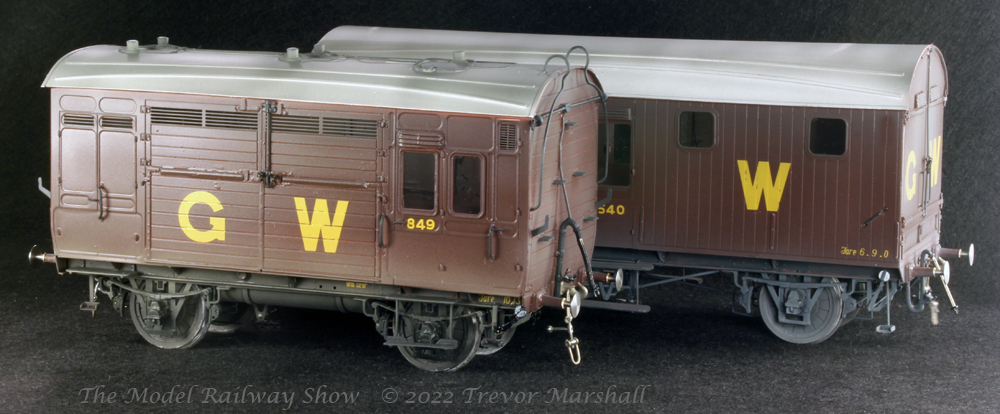
I continue to make progress in the workshop, building models of equipment used on the Great Western Railway at the dawn of the 20th Century. While most of my projects have been goods wagons (or “freight cars” in North American parlance), I’ve also tackled some other subjects.
The GWR had a variety of equipment that fell into the category of “non passenger-carrying coaching stock”. As the phrase suggests, these were vehicles that were equipped to run in passenger trains, but did not carry passengers. Since “non passenger-carrying coaching stock” is a real mouthful, and given the colour they were painted, they became known colloquially as “brown vehicles”.
The two models in this post are examples of those. I built both from photo-etched brass kits from Walsall Model Industries, with wheels, buffers, and couplings from Slaters.
The “Paco” horse box
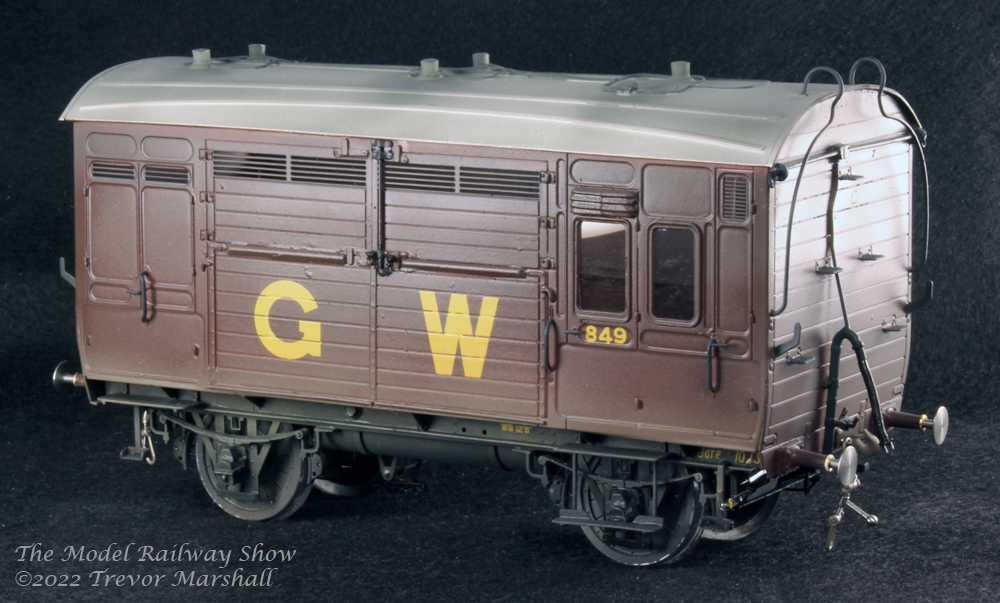
Horse boxes (telegraph code: “Paco”) were interesting cars, designed to transport high-value animals such as race horses. This example has three sections. The large centre section is the horse box itself, with room for three animals. The top half of the door split in two, like a saloon door, while the bottom half dropped open to form a ramp from pen to car.
Two one side, the section with windows is the groom’s compartment. Yes, the groom rode with the horses. At the far end, a closed compartment provided space for fodder and other supplies required for the care of the animals.
I made a small but noticeable goof on this model: I added roof-top piping to all of the vents, thinking they were gas lighting. In fact, only the vent over the groom’s compartment was a gas lamp. I’m not going to lose sleep over this. Not much, anyway…
The “Python” covered carriage truck
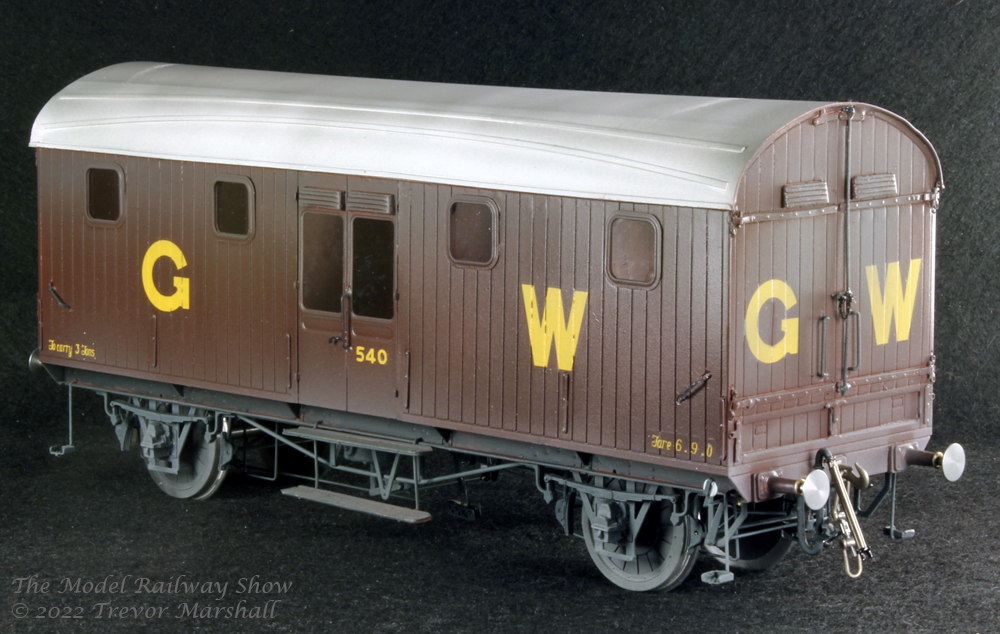
The covered carriage truck (telegraph code: “Python”) provided weather-proof transport for large items. Originally designed to transport carriages or other horse-drawn vehicles, they were later used to move early motor cars. Interestingly, the railway also found them useful for hauling theatre sets for travelling productions.
These vehicles were designed to make best use of the loading gauge – a measure of what will fit under bridges and through tunnels. To give you an idea of the size, here’s the Python posed with an Iron Mink – a fairly common GWR goods wagon from the Edwardian era:

These two brown vehicle models are the result of a conversation I had with my friend Terry. I had mentioned in an earlier post that I was not sure what to do with the Dean Single I had acquired. It’s a gorgeous locomotive…
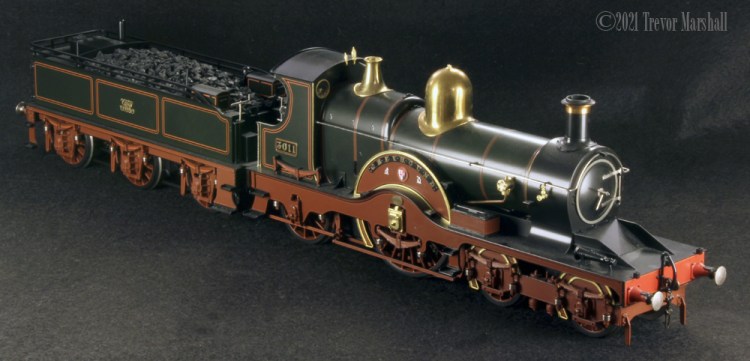
… but it was designed for high-speed passenger service and unlikely to have found its way onto a lowly branch. I noted that I did not care: “The Dean Single likely would never have turned up on such a line. I’m good with that. I’ll run it when nobody’s looking.”
But Terry got to thinking and suggested that I could use it for a “Director’s Special”. Perhaps a GWR director has a country house near the end of the branch, and when he needs to rush to London on business a special train is ordered up. In addition to whisking him to headquarters, it would haul his carriage and team of horses to provide transport fitting of his stature while in the city.
Yes, it’s a bit of a contrived solution, but it gives me a reason to run such a wonderful locomotive. It also prompted me to build a couple of kits that provided a nice change to the Minks and Opens I’ve been assembling. And I learned about the brown vehicle fleet. So thanks, Terry – for all of that!
Now… what other equipment would be found in a Director’s Special? Obviously, this nabob of the rails needs a passenger car to ride in. Anything else? Time to do some research…
 The Model Railway Show