I’m continuing my series of equipment portraits with a look at the S scale freight motors I’ve built for the Niagara St. Catharines & Toronto Railway, a CNR electric line that once served the city where I grew up.
Let’s start with the models I call “The Three Sisters”…
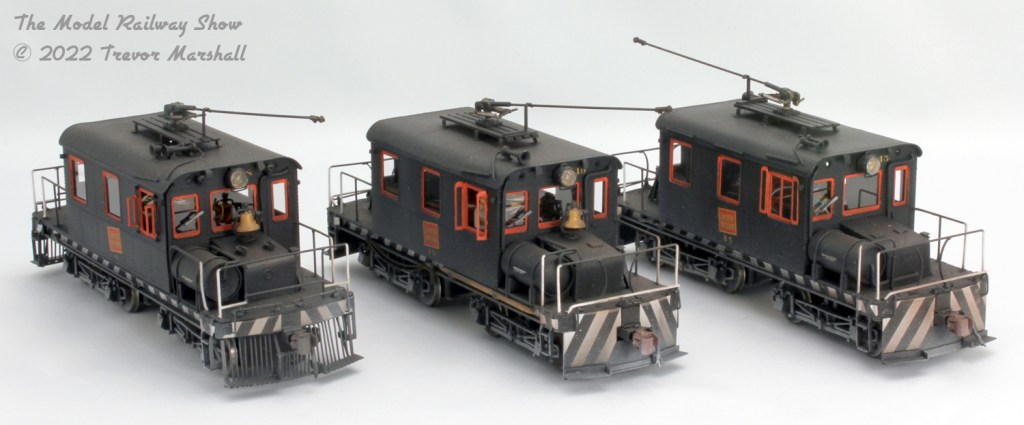
I’ve included more details about each model below, but I built each of these from the same starting point: A set of brass photo etches for the body an frame from the original “NS&T in 1:64” modeller, William Flatt.
William also supplied a number of white metal castings – including his 8′ wheelbase Alco-Allen truck side frames – and the trolley pole. I added scratch-built air tanks plus details from a number of suppliers – including BTSRR, Precision Scale Co., and Q Car Company. I like how these three units express a family appearance while exhibiting unique details.
I’m not sure when the CNR Tilted Wafer paint scheme was first applied to these units, but it features in most 1950s-era photos and lasted until sometime in 1959.
Each model rides on a pair of Northwest Short Line Stanton Drive power trucks, controlled via an ESU LokSound V5 decoder enhanced with a PowerPack module and loaded with a customized sound package.
NS&T 8

This freight motor – the second to carry the number 8 on the NS&T – was a 44-ton unit built by the railway in its own shops in the early 1920s. Unlike its sisters, this one retained its tube pilot, earlier-style handrails, and globe style marker lamps until it was scrapped in 1960.
NS&T 15

This NS&T built this freight motor in 1925. It’s listed as a 50-ton unit, although it follows the same general pattern as the lighter Number 8 (above). At some point its handrails were modified, and its tube pilots were replaced with sheet metal. Construction was simlar to Number 8 although William had mostly assembled the body etches when I purchased this one, which gave me a terrific head start on building an NS&T fleet.
NS&T 19

The NS&T built three freight motors to a similar design. The railway built Number 19 in 1925. Originally numbered 16, it was transferred within the year to the Montreal & Southern Counties Railway – a CNR electric operation in Quebec – where it ran as number 325. It returned to the NS&T in 1936, where it became number 19 and was scrapped in 1960. As with 15, William had assembled the body etches when I purchased it from him.
These were the first three freight motors I built. They proved to me that I could solder together a fleet of motive power for the NS&T – the first step towards determining whether I can model this railway in 1:64.
I’ll share portraits of more NS&T freight motors in a future post. As I add to this series, I’m collecting all of these posts under the Portraits Category to make it easy to find them. Enjoy if you browse.
 The Model Railway Show