I continue to ponder what sort of layout to build. The question has bothered me since moving into my new space in September 2020. But over the holidays, it occurred to me that I need to step back and frame the question differently. Maybe the issue isn’t “What layout?” but “What layouts?”
I had some help with this.
One of my favourite thinkers about the hobby is Lance Mindheim. Years ago, he self-published an important book on layout design:
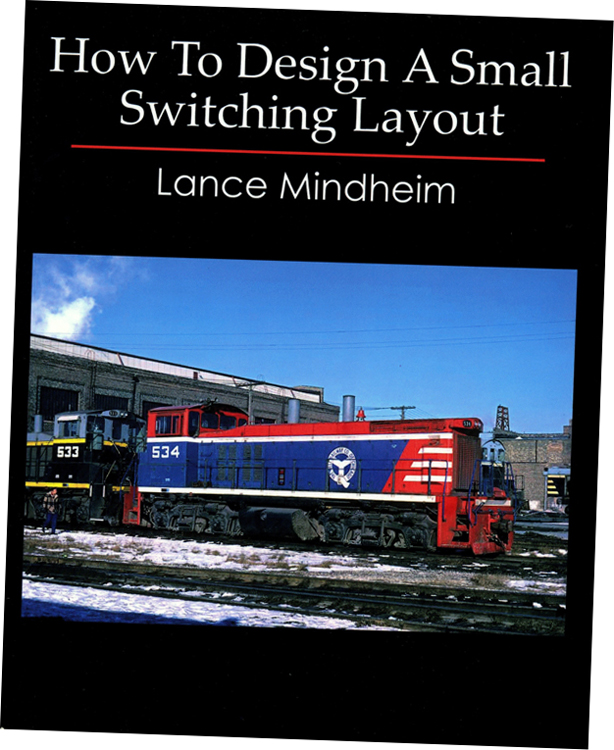
I think this is a book everyone in the hobby should read – regardless of whether they want to build a small switching layout. That’s because the most important part of the book has nothing to do with what we traditionally think of when we think of layout design. It’s not about curve radius, or turnout size, or aisle space.
Instead, the big takeaway is what Lance called “strategic planning issues”.
These include our current construction skills and our interest in learning new ones… the time and money we have available to devote to building and maintaining a layout… our attention span… and the number of people we can realistically rely upon to help build and operate the layout. They also include an assessment of one’s interests in the hobby – from era and theme to the aspects of the hobby (operations, structure-building, scenery, locomotive and rolling stock detailing, etc.) that appeal to one the most.
Lance points out – and I think this should be printed at the top of every blank sheet of graph paper – that ignoring strategic planning issues while focusing on technical issues like track spacing and minimum radius “will often result in correctly drawing the wrong layout. In other words, a layout that is technically correct but isn’t a match for your lifestyle and interests.” That’s great advice.
Lance expanded on his thoughts more recently in a 140-page book that’s as close as your local chooch emporium:

Kalmbach published this in 2021 and I somehow missed it – although to be fair, we all had a lot of things going on that year. I picked up a copy as 2022 drew to a close and it reminded me of those important strategic questions. (Thank you, Lance!)
So, I revisited those questions over the holidays – and that’s adjusted my thinking.
Regular readers know I have a generous if awkwardly-shaped space for a layout, plus a wide range of incompatible interests. Try as I might, there’s no way I can build a single layout that allows me to enjoy the Niagara St. Catharines & Toronto Railway, circa 1959, in 1:64 and the Edwardian era Great Western Railway in 1:43. Add in other interests – such as the Southern Pacific in 1:48 – and it’s obvious I have a tough choice to make.
Or do I?
My space is generous – so why not indulge all of these interests, with shelf layouts? And not tiny ones, either: I could easily fit three 40-foot-long shelf layouts into this space.
My current NS&T Car Barn project was designed to be the start of a larger empire, but also intended to stand on its own if I decide that I do not relish the thought of filling my space with track under wire.
British railway modelling is famous for its shelf layouts – so much so that the GWR BLT (that’s “Great Western Railway Branch Line Terminal”) has become a classic go-to design.
And my Espee interest leans in the direction of a branch or even an industrial spur serving California packing sheds – again, something that would nicely fit on a shelf and enable one to get up close to big models of small steam.
All of these ideas represent niches in the hobby as it’s practiced in Canada – the NS&T for being under wire, the GWR for being across an ocean and a century, and the SP for being Proto:48 as opposed to the far more common O gauge. All, therefore, require dealing with suppliers who are often the sole source of critical components and almost certainly in another country.
I can’t zip over to the local shop for anything more complex than basic materials such as paint, glue, and styrene. So having multiple interests might mean that when I’m waiting a month or more for a needed supply to arrive from south of the border or overseas, I can simply switch focus and work on a different layout. The same holds true when I run into a confounding construction puzzle – or just get frustrated/tired of the current project.
There are other compelling reasons, too…
One thing I have realized since moving is that I’m far less likely to be hosting large groups of operators in Saskatoon than I was in Toronto. My previous layout – Port Rowan in 1:64 – was really only designed for one or two operators, yet I often had groups of people visiting and the layout simply couldn’t support five or six.
I thought that might be the case here and my initial thought was that I’d want a layout that could keep a half-dozen people entertained. But I now suspect I’m more likely to be running trains by myself. Having multiple layouts would give me a choice of what to run depending on my mood. This would also give one or two guests some variety, too.
And of course if a half-dozen people did show up, there would be nothing stopping us from running all of the layouts simultaneously.
The key, I think, would be to make sure each of the layouts has its own character. This would extend beyond prototype and appearance to purpose and operating scheme. My current trio of interests already have that baked in:
My NS&T Car Barn has “engine terminal / motive power depot” vibes written all over it. And operating under wire is definitely novel.
The GWR is already a novelty in North American hobby terms – from its use of three-link couplings to the very different ways in which real railroads evolved across the pond, as reflected in everything from track arrangements to train consists.
The SP in Proto:48 is arguably the most mainstream theme in my basement, at least for North American modellers. That said, it would make for a tightly focussed study of the mass and movement of O scale equipment and would lend itself nicely to what I refer to as “finescale ops“.
This approach is an opportunity to travel the roads not taken – to explore ideas and either embrace them outright or put them to rest for good. I’ve had many of these competing interests for some time – and, for me, none of the three I’ve outlined here has ever resulted in a layout.
Maybe by building two, or three, or more smaller layouts will enable me to determine which theme deserves a bigger canvas, and which can retire to the display case.
This seems like as good a time as any to find out.
 The Model Railway Show