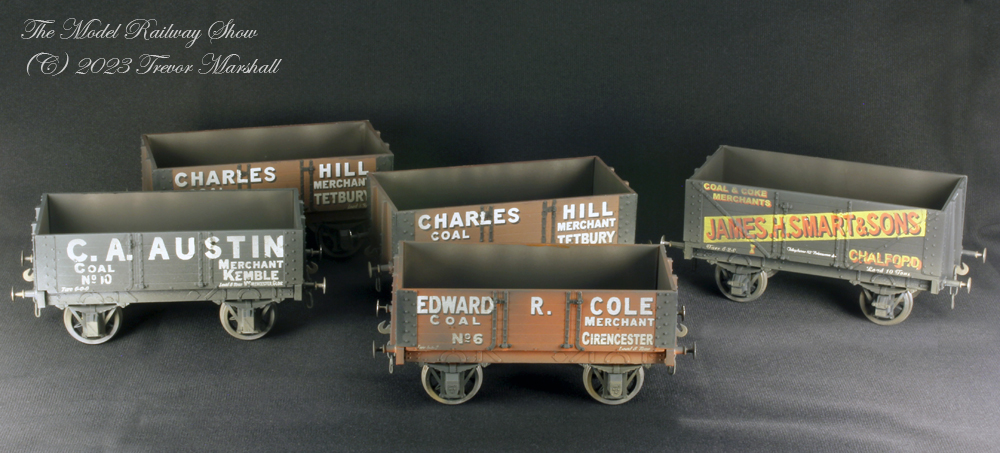
British railways moved coal – a lot of coal – and much of it was transported in private owner wagons. As the name suggests, these freight cars were owned by the coal companies, not the railway. Compared to the austere paint schemes railways used on their own goods wagons, private owner wagons were often treated as rolling billboards. The name of the merchant and their location would be prominently displayed, as on the above examples.
These private owner wagons can serve several purposes on a model railway: they’re a source of significant traffic, they add a much-needed touch of visual variety to a train, and since they can help set the location of the layout for visitors.
A UK company, POWSides (short for “Private Owner Wagon Sides”), offers an incredible range of lettering for private owner wagons. What’s more, the modeller often has a choice of buying the lettering sets or buying a kit with sides prepainted and lettered to order. I opted for the latter – and with an atlas close to hand, I picked up five kits pre-decorated for coal merchants in and around Tetbury.
These are Slaters plastic kits of their usual quality. That said, I noticed right away that these kits do not include any sort of compensating suspension. With a rigid frame, they would act like a four-legged table on an uneven floor: three wheels would touch railhead, but a wagon could rock back and forth diagonally if there was any unevenness. This is a great way to encourage derailments.
Fortunately, I’ve built enough kits from Walsall Model Industries to have mastered that company’s compensation components – and I recalled that Walsall offers these as a separate fret at a reasonable price. I ordered up a batch of Wagon Compensation Units (part CM100). I had to modify the Slaters kits to accommodate these, but it was a straightforward process and I only had to install the Walsall units for the rocking end of the suspension. I built the fixed end as Slaters intended.
The only other modification I made to these was to add weight after finishing construction by pouring fishing sinkers into the frames and securing them with Gorilla Glue.
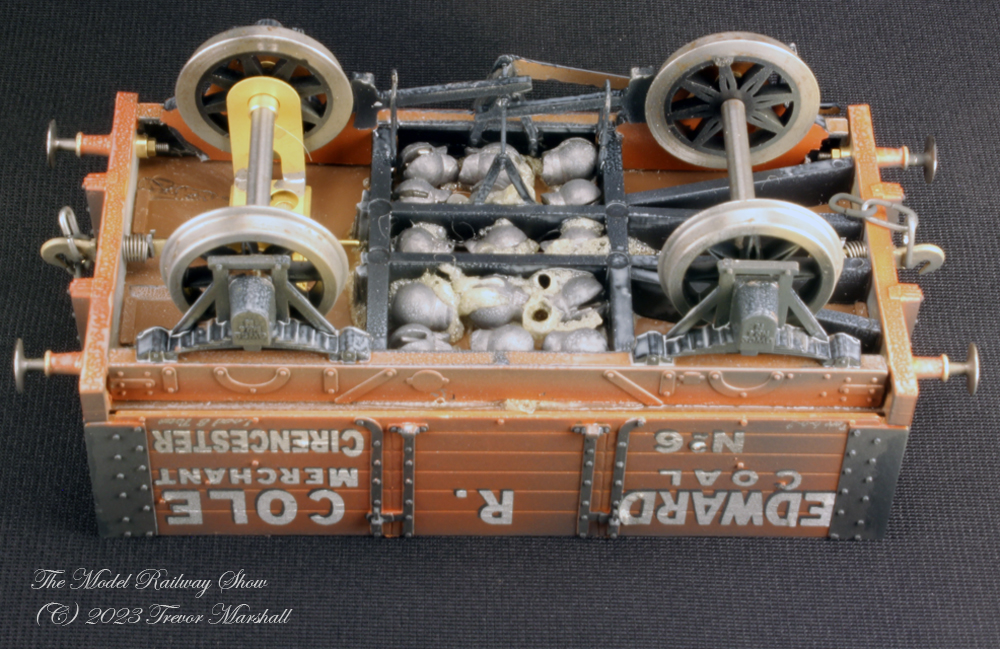
POWSides only paints the outer faces of the sides and ends of these kits so they can be lettered. The insides and all the gubbins below the floor are bare plastic, often in different colours. In addition, building the kits requires a bit of sprue-clipping and filing, which also damages the paint.
For touch-ups, POWSides offers paint matching info for paints available in the UK. As I’m in Canada, I had to improvise. That said, these coal-hauling wagons would get pretty dirty pretty quickly, so I simply picked colours that were close enough and touched up the paint with a brush. I airbrushed the interiors with a mix of colours out of my weathering palette, to simulate coal dust. Finally, I airbrushed the exteriors to represent road dust, grime, and coal smoke. I’m happy with how these turned out.
I have not yet decided on how to make loads for these – or even if I’ll fill the wagons with bagged or loose coal. Whatever I decide, the locals will have plenty of coal to heat their homes!
 The Model Railway Show