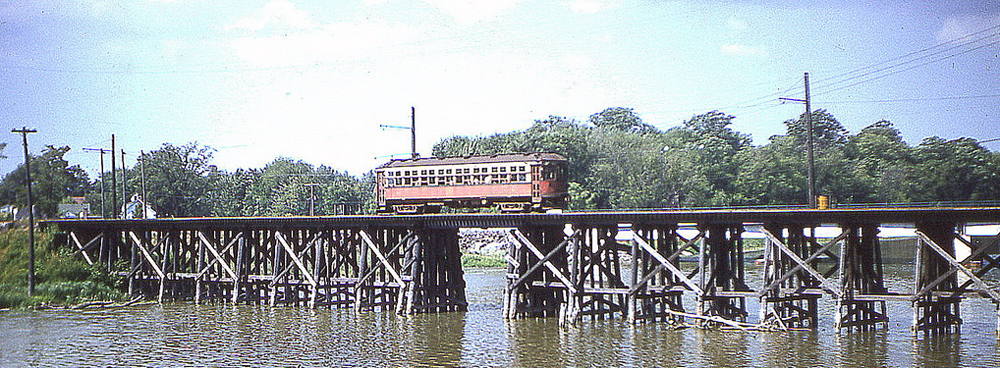
So instead, here’s a nice picture of a Niagara St. Catharines & Toronto Railway train on the bridge over the Welland River in Welland, Ontario to accompany this post about looking for inspiration beyond the train show. (Take that, Shutterstock!)
In yesterday’s post about my banquet speech at Queen City Express, I noted that as railway modelling enthusiasts we can’t engage with other people interested in making things if we limit our public presence to train shows. I’d like to expand on that thought by suggesting more events and venues that we can add to our hobby/social calendar. I present these merely as ideas – in order of relevance to our hobby.
If you’re not already, get on the RPM circuit
Railroad Prototype Modellers (RPM) is a loose association of like-minded hobbyists interested in building better, more accurate, prototype-based models and layouts. Primarily a North American movement, regional RPM meets are held across the USA and Canada throughout the year, and vary in size from a handful of people to a couple hundred. Members share information about sources, tools, materials, and techniques – all in a non-judgemental way. Plus, the models on display at such events are always inspiring.
As a result of the pandemic, a number of RPM enthusiasts established virtual meets. The best-known of these is Hindsight 20/20. This virtual RPM attracted a global following and has proved so popular that the organizers continue to host a one-day event once or twice per year.
It’s easy for those who are not prototype modellers to dismiss this cohort as “rivet counters” but the reality is that many of the amazingly accurate, ready-to-run models we enjoy today can be attributed to the research of people in the RPM community. What’s more, the RPM community operates in the spirit of helping each other to become better modellers. There are no rules (except possibly, “Don’t touch the models on display without permission”)… no dues… and no officials… and no contests. Also, there are few if any egos on display: Everyone at an RPM is there to learn.
As an informal organization, there’s no “RPM website”. But there are several sources online for finding out about the various RPM held throughout the year and they’re just a search away. And if there isn’t a meet in your area, maybe that’s an opportunity to start one!
Check out the IPMS
The International Plastic Modellers Society (IPMS) is the NMRA equivalent for those modellers who focus on armour, aircraft, ships, vehicles, sci-fi and fantasy subjects, and so on: Basically, everything except railways.
IPMS has branches around the world – including in Canada and the United States.
I think the types of railway subjects exhibited at Railroad Prototype Modeller meets would also be well received at IPMS events. And given how the plastic modelling hobby has improved railway modelling through the introduction of materials such as photo-etch plus new new paints and finishes, I think we have a lot to learn from our IPMS cousins.
On the flip side, modelling is modelling, and those builders of airplanes, tanks, submarines, hot rods, and spaceships might be interested in what we’re doing, too.
Join the Maker movement
The Maker movement is a technology-powered extension of do-it-yourself culture. It brings together traditional construction activities such as metal working and wood working with electronics, robotics, 3D Printing, and other technologies. It encourages tinkering, and encompasses both the creation of new things and the reimagining of existing things in ways they were not originally designed to be used.
That description should sound pretty familiar to railway modellers: As a group, we are comfortable with applying technology to our hobby, and we often treat objects as sources of raw materials for our ideas.
Maker Faires are conventions for Makers, while Maker Spaces are community workshops where Makers can collaborate on projects, share ideas, and access tools (from power tools to lathes, mills, laser cutters and 3D printers).
However, there’s a caveat with this: There has been some decline in the number of Maker Faires and Maker Spaces in North America, exacerbated by the COVID-19 pandemic. That said, there may still be a Maker Space in your community.
The availability of any of these will vary from community to community, and sources of information about these will vary in quality and accuracy. The best advice is do some online searching then follow up with and email or phone call.
 The Model Railway Show