This is the story of accidentally designing an Achievable Layout.
I spent much of May on benchwork for the next section of my S scale rendition of the Niagara St. Catharines & Toronto Railway. This section would depict the NS&T’s Niagara Street freight shed in St. Catharines, plus a few nearby industries – all strung along a 24-foot long, two-foot deep shelf. As with my first section of NS&T – the car barn scene – I designed this full-size on kraft paper, using turnout templates downloaded from the Fast Tracks website.
With plan in hand, I put up shelf brackets, making sure they would clear a long row of low bookcases along this wall, and that the shelf they’d support would not block any light switches. Then I built three 2×8-foot sections of benchwork to set on top. So far so good.
But then I temporarily lifted the sections into place – and experienced two visceral reactions:
- WOW – THIS IS HIGH! Clearing all the important storage and the light switches – while also leaving room for wiring the layout, maintaining switch controls, etc. – meant I ended up with the rails at 59″ above the floor. When I rolled out the kraft paper for the NS&T layout design, I quickly determined this would be much too high for an S scale scene depicting a busy freight shed. There was too much track, too far from the front edge of the layout. It would be a construction, maintenance, and operating nightmare.
- WOW – AN O SCALE SWITCHING LAYOUT WOULD LOOK GREAT ON THIS!
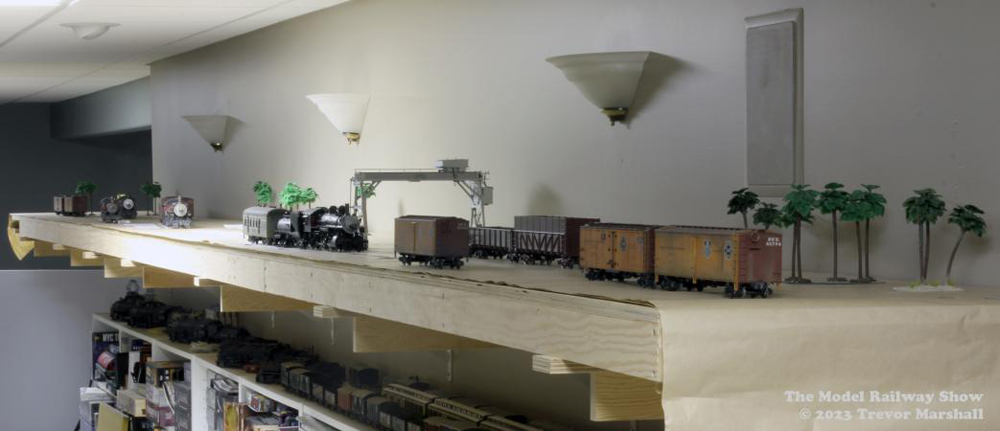
I confirmed this second reaction by hauling out some of my Proto:48 Southern Pacific equipment and setting it on the benchwork:
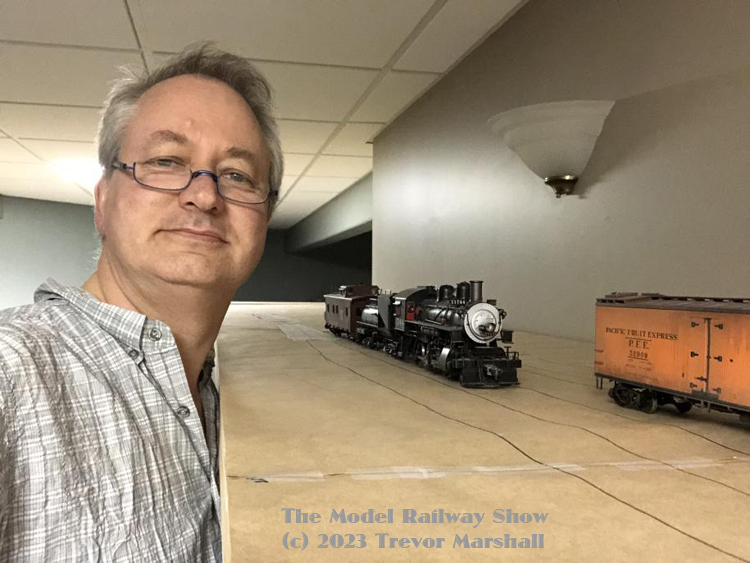
I decided I needed to explore this so I drew a plan – again, full-size on kraft paper. I used #9 and #7 turnout templates (again, downloaded from the Fast Tracks website) because I have an SP book that includes drawings of turnouts in those sizes.
I ended up designing a classic shelf switching layout. I really like the plan – and, significantly, it came together on the first try:
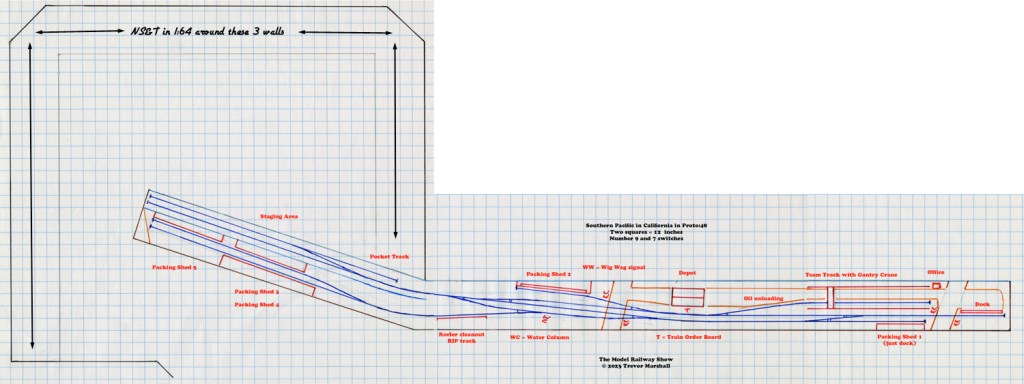
The plan consists of a 24-foot long shelf against the wall, plus a 12-foot long peninsula into the large blob at the north end of the basement. This peninsula would be accessible from both sides, which would allow for a modest staging area behind a backdrop. Importantly, most of the track is within the front 15” where it would be easy to reach.
I would use the walls around the blob for my NS&T layout, set at a more reasonable height. (This means my NS&T layout would be more modest in scope than originally planned – but that nicely supports my thoughts about using my space for multiple layouts.)
This plan depicts a single switching district on the Southern Pacific in Southern California. Once a promising branch line, it’s been severely trimmed back: All that remains is an industrial spur that exists mostly to serve five packing sheds. I have a lot of O scale Pacific Fruit Express ice-cooled refrigerator cars and the main operating challenge would come from the large number of these cars to move during a session. While all the cars would look similar, each packing house might have specific requirements for pre-cooling – so train crews would have to pay attention to each car’s reporting marks and the instructions on their switch lists.
While packing sheds dominate the scene, I’ve also included some other features. A team track – the universal industry – would provide a spot for any non-refrigerator car types. It would also provide me with an opportunity to deploy a brass model of a 20-ton travelling crane, which could be used for unloading pipe from gondola cars: Perhaps there’s a major irrigation project underway, or new water and sewer construction is underway to support California’s suburban expansion. Part of the team track would be dedicated to unloading tank cars of oil to power smudge pots in the orchards.
Finally, there’s room for a small depot. Once an important hub of activity on the branch, it no longer serves passenger trains. But it’s still used as an office for the local customer agent during the harvest rush and as a break room for switch crews.
I envision this layout framed nicely with a shadowbox presentation to complement the finished room in which it would live. The existing wall sconces would come down and be replaced with plug-ins for LED strip lighting. (Frankly, that’s no loss: They’re ugly and do a terrible job of illuminating the space.)
Drapery set back from the front would hide the bookcases underneath, while the space between bookcases and SP layout can be used for a staging area for the NS&T layout located around the corner.
I’m still debating whether to do multiple layouts, but I do like the idea of the variety this would enable. Equally importantly, my wife loves the thought of me modelling Southern California. She thinks it would be the perfect antidote to winter on the Canadian Prairies and argues that we would need to do regular “research trips”. She also points out we’re now a lot closer to California than we were when we lived in Toronto.
I think she’s onto something. Let’s see where this goes…
 The Model Railway Show