We’re probably all seen ads from real estate developers for their projects. These homes typically feature neutral tones, furniture with clean lines, boring rugs, bland art, stainless steel appliances, etc. If there’s a splash of colour, it’s a bowl of wax fruit or a “daring” accent pillow.
Here’s an example of a typical room in a show home, lifted from a video by Australian developer Clarendon Homes for one of their common designs. I picked this example deliberately, as I’ll explain shortly…
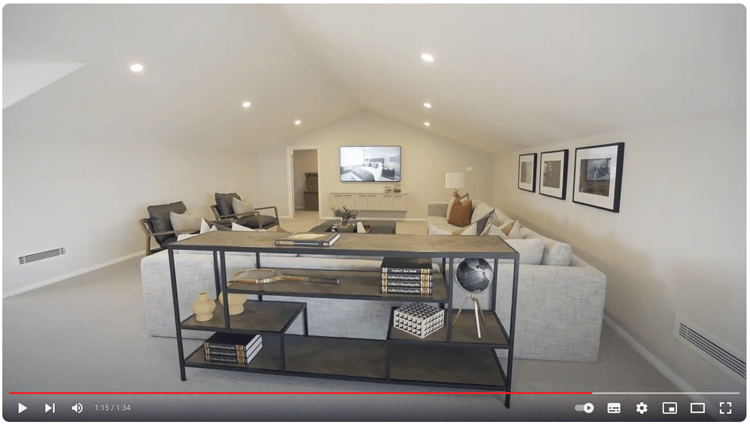
There’s nothing inherently wrong with this. After all, prospective home buyers are supposed to be able to imagine their own lives (their own furniture, art, etc.) in the homes – so the show home staging must be neutral enough that it’s easy for the clients to mentally delete the details and replace them with their own.
But the downside is, every show home (and every house stager for the used market) embraces this same, neutral decor – and that means they all start to look the same. Once prospective buyers have toured two or three homes, the decor would all start to blend together and it would be hard for them to remember which was which.
So I was pleasantly surprised when I stumbled across this report on the Will James: Railways YouTube channel from Australia. For this show home, developer Clarendon Homes partnered with the Guilford Model Railway Group to put a model railway in the loft. Instead of a sectional couch and big screen TV, here’s what greeted visitors:
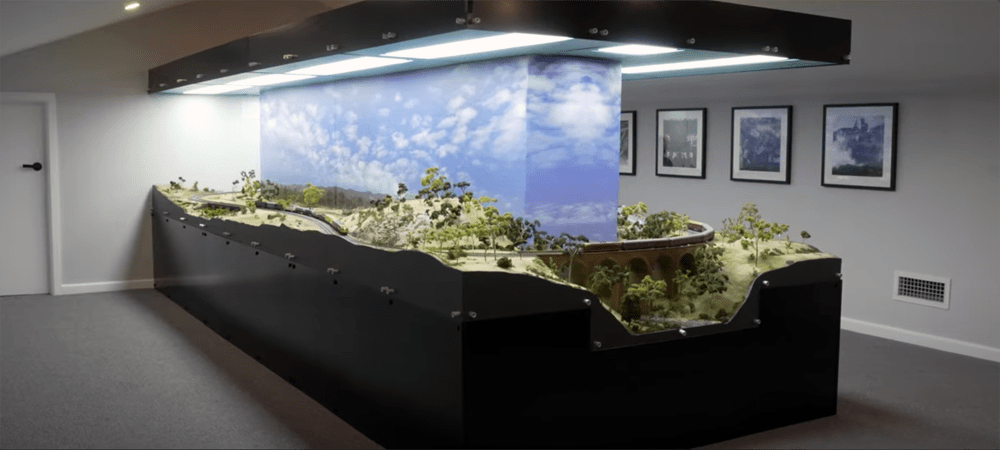
The layout is very nicely done – but the story is not about the layout.
Let’s face it, most people are not railway modellers – and that includes most people shopping for a new home. They’re not going to visit this home, see the layout, and become instant converts to the hobby.
Rather, the story os about how this developer devised a novel way to break through the sameness of the modern home-buying experience. I applaud them for their creativity and for working with a railway modelling club to create something memorable for visitors.
The full video is below, and definitely worth a watch. But here are some things that impressed me:
1 – Word of mouth, features in the homes section of the newspaper, etc., would quickly put this show home on the “must see” list for anybody – just for the novelty. That gets people in the door.
2 – This goes double for parents, who are always looking for ways to entertain the little ones – especially when doing “adult” things like house hunting.
3 – The layout features models of real structures and local landmarks – which encourages everyone to talk about it. (eg: “We saw that bridge on our way here.”) That puts the layout in local context and makes the visiting experience more memorable than would a layout featuring a random collection of buildings from off-the-shelf kits.
4 – After their visit, house hunters may start by talking about the layout, but they’ll move onto the arrangement of the rooms, the finishes, the available upgrades, and so on. And they will be talking about this house, not some competitor’s offer.
5 – Weeks later, they will remember this house – more so than the other ones they’ve visited.
I’ve already cited the models of real landmarks as something that makes this layout work. Other things – important for its purpose – include the top-notch presentation, with solid panels hiding the supporting structure (and keeping kids out of the gubbins) and the clean room with museum-style layout lighting.
The layout also appears like a well-done but temporary exhibit – which it is. As I pointed out, unless they’re already in the hobby, visitors are not going to buy this home and build a model railway in the loft. So they have to see the space as something they can make their own, even with such a “non-neutral” feature in the middle of it.
That said, the layout probably also impresses visitors with just how much space is available in this room. If this fits, they’ll have no problem putting their home theatre in there.
The club that built this layout deserves credit for how well it addressed the needs of this project. Building signature scenes and structures is one way club members achieved this. But there are others:
6 – Such a layout has to run reliably. To ensure this, the track plan primarily consists of a double track oval. There are a few extra turnouts, but not enough to cause problems – and if they did, they could easily be spiked closed. (Maybe they are already? There’s no reason for them to be working.)
7 – There are no grades or hidden areas, which can contribute to reliability challenges.
8 – The layout uses motion sensors to start the trains running when people enter the room – and stop them after the people have left. This saves wear and tear on the models.
9 – The presentation is low enough for all members of the family to enjoy (see point 2, above).
10 – The layout includes professional looking, clear acrylic panels that protect it from curious hands – which are also easily removable for cleaning the layout, maintenance, etc.
I imagine that some of the club members had to set aside their own preferences (and egos) in order to build what the developer needed. I know I would. So kudos to them! They hit this one out of the park.
If you’ve read this far, here’s your reward. Enjoy the tour:
Special thanks to Will James for creating and sharing this video. I encourage you to subscribe to his channel and have a look around. For starters, if you know nothing about Australian railway modelling, Will’s channel is a great way to discover it. I’m struck by how it’s so similar, yet so different, from what we know in North America.
 The Model Railway Show