In an earlier post about Australian railways, I blamed Stephen Gardiner. It’s not fair – but I’m still blaming him*.
As noted in that post, I ordered some HO scale kits for Victorian Railways goods wagons (freight cars), because I was curious about modelling at the other end of the world and because I want something novel to build.
But the completist in me grated at the idea of having a few pieces of rolling stock without a locomotive to round out the collection and create a train. And, well, once I started investigating locomotives I found there are so many neat prototypes that I couldn’t decide on just one.
So, I browsed the site of an Australian hobby shop, flexed my flexible friend (the credit card), and here’s what arrived. I’ve included some prototype notes (from Wikipedia), plus my own insights, based on my very limited understanding of VR railroading.
Victorian Railways T 364…

Victorian Railways ordered a total of 94 of these T Class diesel electrics, which arrived on the property between 1955 and 1968. They were built by Clyde Engineering, but are essentially EMD G8 clones. The G8 was a four-axle road switcher built by EMD in the US and GMD in Canada, and designed primarily for export markets. (According to the CNR Historial Association, six G8 models – numbered 800-805 – operated on the Newfoundland Railway from 1956-1986. But I digress…)
For North American modellers, these locomotives are about the size of an SW1200RS and I get the sense they performed similar roles as branch line road switchers. Wikipedia notes a number are still in service, while several more survive in preservation.
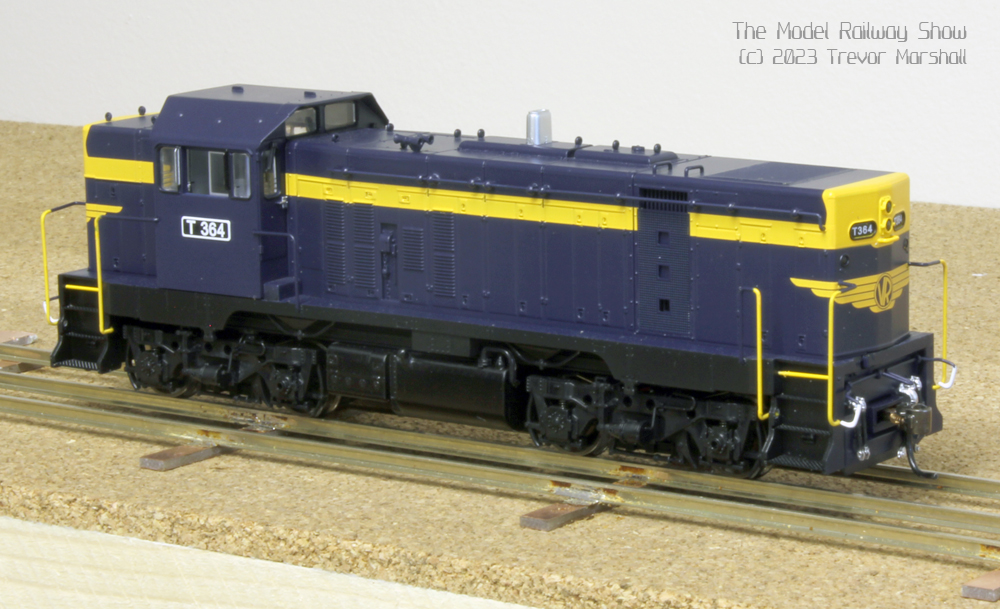
T 364 is an HO scale model from Powerline Models. It’s very nicely detailed and runs well. The short hood is designated as the “front” although it’s obviously comfortable operating in both directions. My model is factory fitted with a LokSound V5 decoder loaded with a custom sound file from DCCSound and has an extensive lighting package. As a sound-equipped model, it could benefit from an ESU PowerPack stay-alive module for the decoder. I have no idea if there’s space under the hood but will investigate at some point.
Victorian Railways W 265…

Tulloch built 27 of these tiny W Class locomotives in 1959. They’re based on a German design and fitted with a Mercedes Benz V12 and Krupp hydraulic transmission. Power transfers to the centre axle, with side rods connecting the other two. While tried on passenger trains their 40 mph top speed was too slow for this service. The top gear was removed – reducing their maximum speed to just 20 mph – and they were relegated to switching duties.
In the 1970s, a number of W Class locos were repowered with an GM prime mover. According to Wikipedia, these were unpopular locomotives, with a rough ride, reliability problems, and visibility issues. Five have been preserved.

I added W 265 to my cart after watching a product review online. The manufacturer – IDR Models – has done a great job on this pint-sized power. It features a LokSound V5 with custom sound package from DCCSound and – unusually – is factory-fitted with a stay-alive for the decoder. (This is something I wish more manufacturers would do. It would be a better use of their development time and money than some of the “extra features” they include on their models.) Based on the prototype’s track record, this could be an unusual case of a model performing better than the real thing. It’s a nicely-weighted model, a smooth and slow runner, and has superb sound and lighting. It would work beautifully for an Australian-themed micro-layout.
Victorian Railways 60 RM…

If this looks like an Electo-Motive Corp (EMC) gas-electric, that’s because it basically is. Victorian Railways received its first EMC self-propelled railcar in 1927 as a kit, which was assembled at the Newport Workshops. Newport constructed the bodies for nine more, which were fitted with imported equipment and electrical components. The final railcar went into service in 1931. Originally, these were fitted with petrol (gasoline) engines, but they were retrofitted in the 1950s with diesel prime movers.
These were long-lived units, with the last one being withdrawn from service in 1991. Nine of the 10 have been preserved, with four of those in operating condition. Five matching trailers were built in 1930 and withdrawn from service in 1982. One trailer is confirmed as scrapped and at least one trailer has been preserved.

I really like railcars. I have a lovely S scale gas electric which I’ve painted for the CNR (even though it did not own this style of self-propelled car). I have a few O scale models of two-foot gauge Sandy River & Rangeley Lakes railbuses. And I recently wrote about an HO scale model of a Boston & Maine doodlebug (that I built a couple of decades ago from an Australian kit). So it’s no surprise this model found its way into my shopping cart.
My model of number 60 was manufactured by IDR Models and is in the 1970s-1980s scheme with a brown roof. It’s factory fitted with a LokSound V5 with custom sound package from DCCSound and a stay-alive for the decoder. The stay-alive is built into a circuit board and has a switch underneath to cut it out for programming – not as elegant as using a Loksound-compatible PowerPack, but still a far cry from not having a stay-alive at all. So, top marks to IDR for this. The interior is detailed and has passenger compartment lighting (on a decoder function, so one can turn it on or off as needed). IDR provides window shades as separate items, which I’ll install at some point.
These are all nicely finished models that run well and sound great. I will need to add a crew to each (and passengers to the railcar), as well as apply some weathering to bring out the details – especially around those black underframe areas. I’m glad I made this investment and while they’re destined to spend most of their time on a shelf I look forward to hauling them out and running them on any HO layout that’ll put up with my eccentricities.
But meantime, I have a few VR goods wagons to build.
(*And yes, I’m joking about blaming Stephen. I’m glad he put me onto the Australian thing. It’s all good!)
 The Model Railway Show