If you’re reading this in Canada or the United States (or Mexico), your hobby is about to get a lot more expensive.
It’s less about the direct cost of hobby goods crossing borders and more – a lot more – about the fact that everything is about to get more costly. In an environment in which food, energy, housing, and other essentials will demand a greater percentage of your income, your hobby budget is going to take the hit.
As railway modelling enthusiasts, we need a strategy to ensure we continue to enjoy the hobby during what could be a long, drawn out trade war.
It didn’t have to be this way – but it is and for most of us, the only way to influence the outcome is with our vote at election time. But as people who rely upon railway modelling to provide us with important social and emotional benefits – including community, personal satisfaction, and sanctuary from everything else that our lives throw at us – we can’t just jettison the hobby if (or, more likely, when) the economy slips into a recession.
That said, we’re going to have less disposable income to buy hobby stuff. Our response will require more than just being smarter about what we buy – and from what country we buy it. For many of us, we will need to radically rethink how we engage with the hobby.
That’s a big question to ask oneself, but the answer is likely right in front of you – at your kitchen table, desk, or workbench.
For me, anything I get to build is going to provide a better return on my investment. That means spending less money on ready-to-run and more money on kits or basic materials to scratch build models. (I already do this, but I’m doubling down on it.)
That applies to every aspect of the hobby – but here’s one common example: If you haven’t already done so, this is an excellent time to learn how to build a resin kit.
In the context of making your hobby dollars go further, the benefit here is the much lower cost per hour of hobby enjoyment. It takes mere minutes to unpack a ready-to-run boxcar and put it on the layout, but many hours to build and finish a resin boxcar kit. If each option costs $65, the resin kit is the clear winner in making that $65 stretch further.
There are other benefits, too. A ready-to-run boxcar (or ready-to-plant tree, or ready-to-use structure) cannot provide the same degree of satisfaction that comes from pointing to a finished kit or scratch-built model and saying “I built that”.
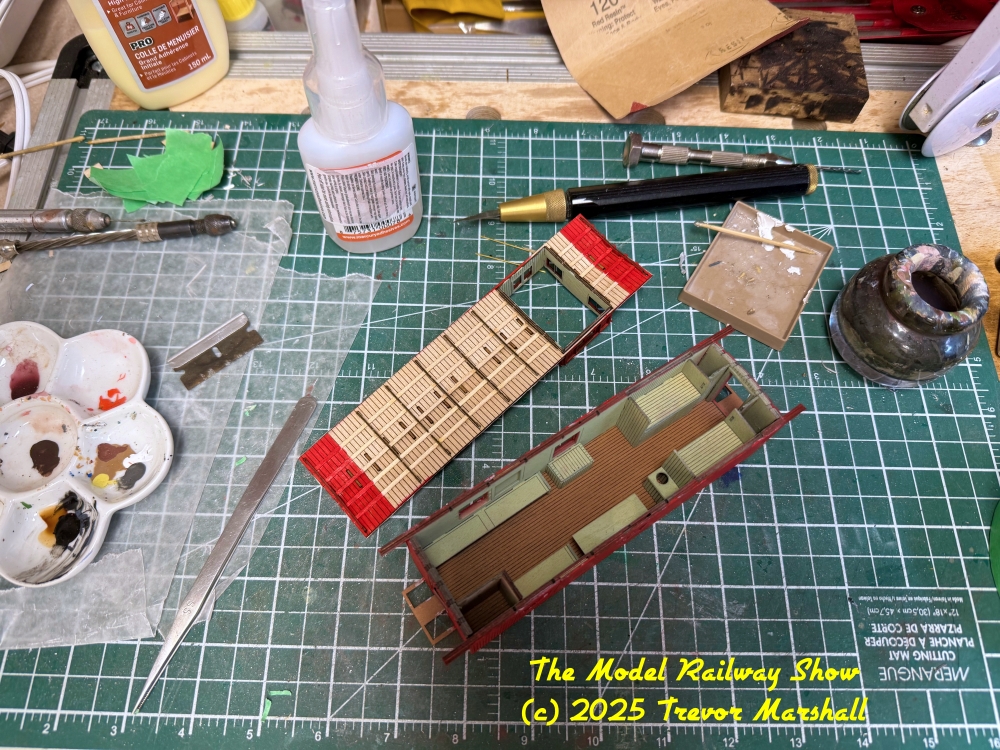
A ready-to-run model cannot provide the same opportunity for skill building. (I currently have a pair of craftsman caboose kits on my bench for my S scale NS&T. They’re definitely challenging me to learn new skills. And the cost per hour of hobby time is definitely attractive.)
A ready-to-run-model will not encourage you to consider whether you need less layout – not more – to be happy in the hobby. That’s a money-saver, right there.
Transitioning your hobby from “driven by buying” to “driven by building” may require an upfront investment. You may require some additional tools, for example. But pay for quality and they’ll last you a lifetime.
If you have not previously built such a model, there are many suppliers of quality kits.
For my fellow Canadians (especially those who work in HO scale), I recommend two sources:
- You can pick up a complete, ready-to-build kit from the Yarmouth Model Works shop. If you drop Pierre an email, he can probably provide some advice about which of his kits are easiest for someone new to resin-building.
- Ryan at National Scale Car offers a number of mini-kits that allow you to transform a basic car you supply into a prototype-specific model.
Pierre and Ryan are both in southern Ontario, so you’ll be supporting homegrown talent.
Another strategy is to commit to building what you already have. I have lots of kits that I bought on a whim, or for that “someday” layout. Well, that someday is here. (I recently built one such purchase – a ridiculous, whimsical On30 Aerocar that sat in the to-do pile for some 15 years. It provided a delightful week of hobby time for the price of glue and paint.)
I have more such projects. These include several kits for my NS&T layout and my 7mm Great Western Railway interests, but also a number of stand-alone projects that I want to build simply because they’re neat. I’m digging these out, organizing them by priority or interest, and getting them in the queue.
I’m furious at the person who has imperilled the century-old political and economic relationship between Canada and the United States that has greatly benefitted both parties. We are all going to suffer for this – on both sides of the border – and even if it’s resolved quickly and amicably, a century of trust has been violated and it will not be restored in my lifetime. That’s a shame.
I hope this economic disruption does not last long, and I hope it does not hurt any of us too severely. But it’s impossible to predict any of this. In my opinion, the only thing we can do to ensure we can continue to enjoy our hobby is to insulate ourselves, as much as possible, from the negative effects of forces we can’t control.
Good luck.
 The Model Railway Show