As noted in a previous post, I have deployed garden scale switch stands to control the turnouts on my S scale version of the Niagara St. Catharines & Toronto Railway. These work very well, but they do take up a fair bit of space on the fascia to make them comfortable to work: A single stand is mounted on an eight-inch wide shelf, while a pair of stands require 12 inches.
This posed a problem for me when planning the area occupied by the Geneva Street terminal. This is a busy area, with seven turnouts in the terminal itself. Moreover, Geneva Street is co-located with another scene – Woodruff’s Siding and its three turnouts. Using garden scale switch stands would not only add several feet worth of shelf, but would also become pretty confusing for operators.
Fortunately, for most of its life the Geneva Street terminal trackage was controlled by a switch tower located at Niagara Street. This tower was gone by 1959 – the year I’m modelling – but had been in use into the early 1950s. I decided a compact lever frame would solve my cluttered fascia issue while offering an interesting construction challenge. What’s more, I now have an excuse to build a model of the Niagara Street tower.
For the lever frame, a friend in the UK alerted me to a nice kit offered by the ScaleFour Society. This is an etched nickel silver kit that builds into a five-lever frame. It’s designed to accommodate SPDT lever switches to control switch motors, or mechanical linkages such as the Bullfrog switch controls from Fast Tracks, and multiple kits can be ganged together for larger installations.
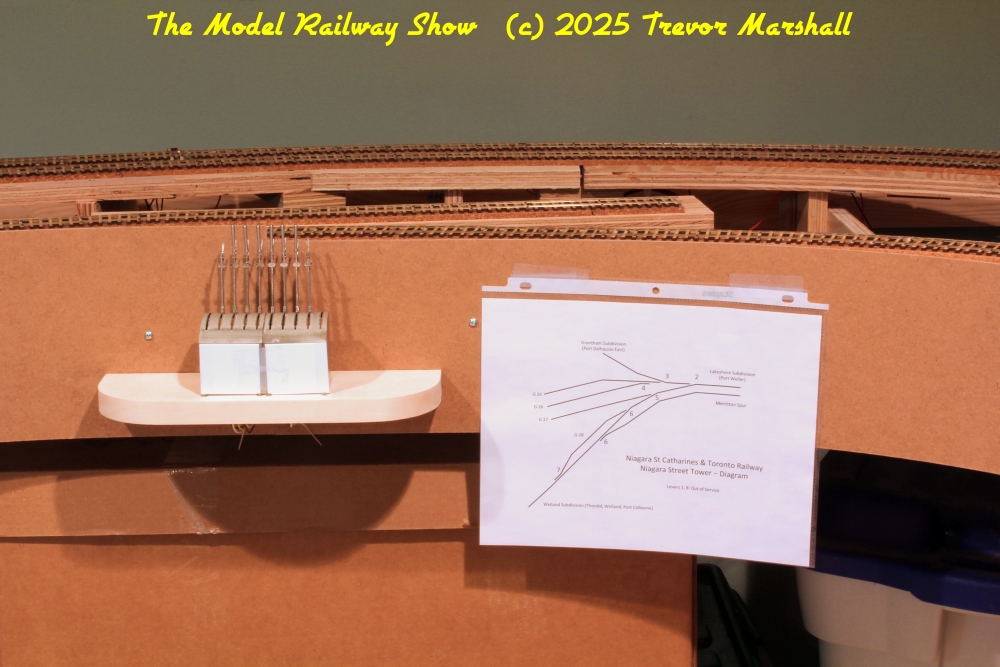
I needed six levers to control five turnouts plus a crossover. In addition, the Niagara Street tower controlled two sets of manual crossing gates – protecting trains at Niagara Street and Welland Avenue – so eight levers would be plenty. I ordered two kits, plus SPDT lever switches and two packages of lovely, turned handles.
The kits built up beautifully and the resulting lever frame works really well. I built eight levers and wired up their switches, but left the handles off levers 1 and 8 to indicate they’re not currently in service. If I decide to add the crossing gates, I’m ready to control them. A printed diagram helps operators understand what each lever does.
On the NS&T, this frame is a simple, compact control that meets the need while providing some rewarding play value. But a friend of mine is using the same ScaleFour kits to build a properly interlocked lever frame to control the switches and signals for Bydemill – my 7mm Great Western Railway layout that shares the same space as the NS&T. I’m sure he and I will be comparing construction notes as he progresses on that project.
 The Model Railway Show