
In the UK, railways started connecting communities hundreds of years after the villages and towns were established. As a consequence, the land expropriated for station grounds was often outside of town. This meant that upon arriving at the terminal, travellers and goods were still some distance from their final destination.
This is the case at Bydemill – the end of the line on my 7mm scale Edwardian era Great Western Railway layout. As with Highworth, the place on which my imagined community is based, the centre of town was a quarter mile (two furlongs) or so up the road from the depot.
At the dawn of the 20th Century, many passengers of the GWR would have walked to and from town. Goods would’ve been conveyed by wagons – either railway-owned and operated, or private.

I was able to find a nice selection of carriages, wagons, and other horse-powered vehicles – plus suitable horses to pull them – from manufacturers including A.B.S. Sidelines (now offered by John Day Models) and Phoenix (part of the S&D Models line).
I’ve had some of these kits for a while but when I went to order more from one of the manufacturers I ran into postage difficulties (not US-tariff related as I’m in Canada. Possibly my own fault – although my money was refunded with no explanation provided and an email would have cleared up matters).
Fortunately, my friend Simon Dunkley was kind enough to act as broker and freight forwarder. (Thanks, Simon!) He also helped me out with some coach lamps for my Hansom Cab, and with a replacement wheel to solve an issue with one of the wagons.


These white metal kits go together nicely with files, a hobby knife, and CA – and the resulting models are full of character.
I was concerned about painting horses – I have painted lots of people, but I’m still new to animals. But I found several images online, printed them out, and referred to them frequently as I finished the figures. Every horse on the layout is painted based on a specific, real horse. (No, I don’t know any of them personally: If you see your horse modelled here, that’s just coincidence.)

I added reins using fine copper wire – the sort used to re-wind small motors – which I picked up at an electronics surplus store many years ago. The reins are threaded through small eyebolts that I mounted in suitable places on the horses’ harness. Some online sleuthing turned up a suitable diagram of the hardware required for the two-horse team, including how to hook up the reins.
I enhanced a couple of the models with simple signs, which I created on the computer and printed onto decal paper. I chose the merchant names from a 1903 copy of Kelly’s Directory for Wiltshire, which I found online and which included business listings for Highworth.

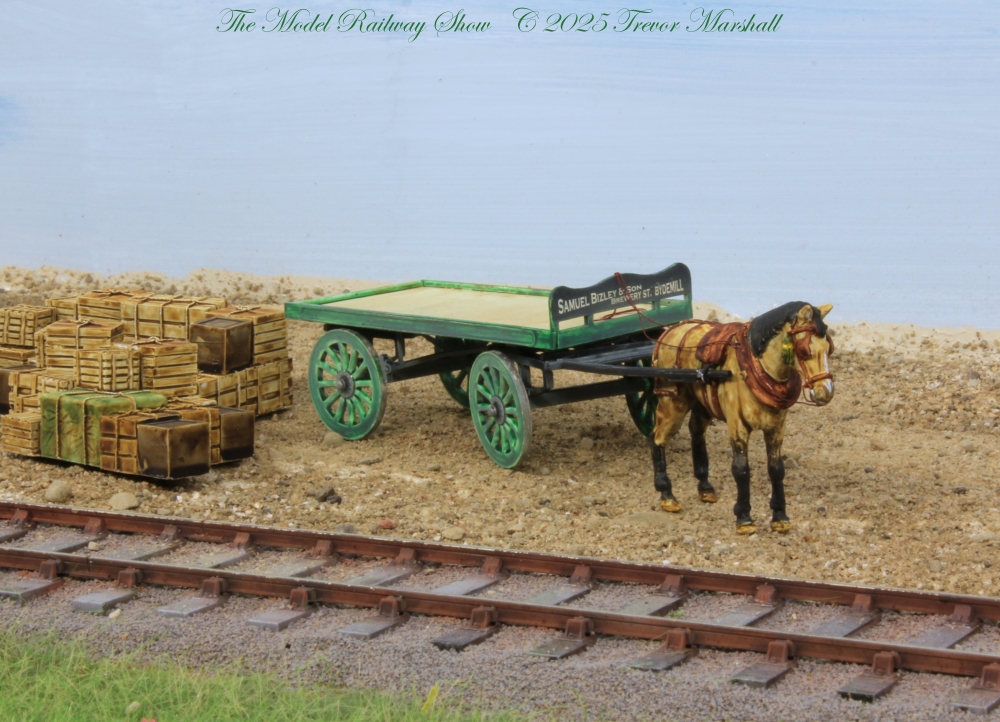
Now that I have finished the horses and wagons, I need to add some people – carters and general labourers – which I have ordered from Modelu in the UK. One or two of the open wagons would benefit from loads, too. Those are in the works now…
 The Model Railway Show