Yesterday, my friend Cal came over and together we put CNR Pine Street – my HO scale portable layout – through its first real sea trial. Would it prove seaworthy? Would an experienced operator who is unfamiliar with the layout have enough information to operate it successfully?
I’m pleased to report the layout passed. It ran well – no stalls, no derailments – and I gained some ideas about what paperwork to produce for shows if I want to let the public have a go at operating it.
If I have to cite any issue, we had a few false couplings (where a freight car got pushed along instead of coupling). These were due to well-rolling wheel-sets and the very slow speed and significant momentum programmed into the locomotive. It’s rare to complain that wheel sets work too well, and locomotives run too smoothly – but here we are. It’s a nice problem to have.
Cal and I ran the layout three or four times and were so engaged I didn’t pause to take photos. So I ran a session this morning and photographed it…
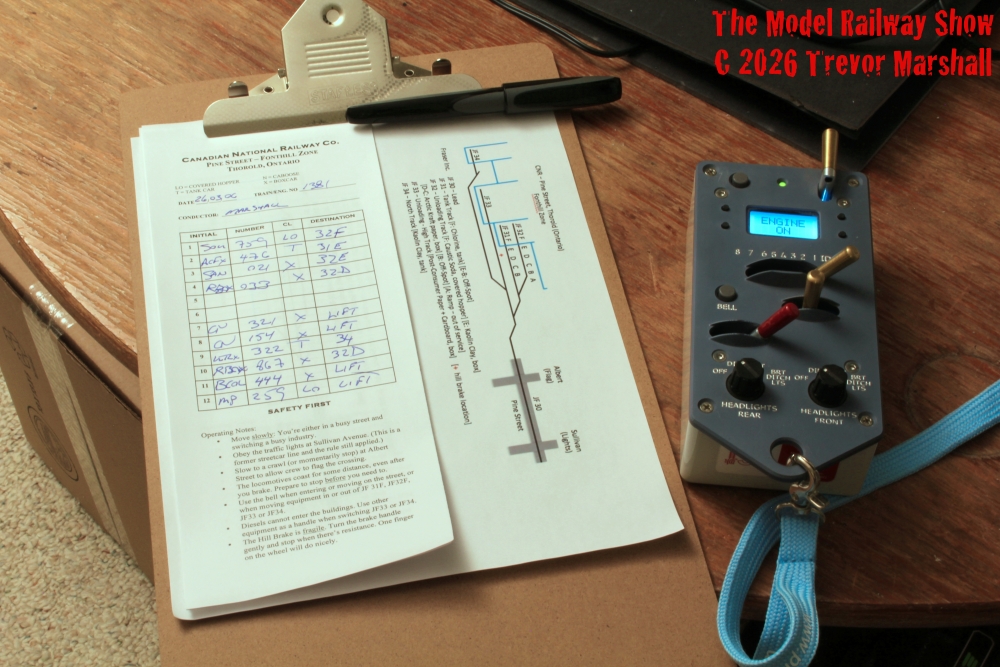
I want to keep paperwork for this layout to a minimum: People want to run trains, not fill out forms. And many potential operators will have little to no experience with switch lists, etc.
I designed three variants on a switch list. Once I pick a style and refine it, I may fill out a sequence of switch lists for shows that automatically reset at the end of the sequence (so if I have six switch lists, each builds on the one before it, and the sixth list resets everything to the first list). I would need some blank lists in case I have a problem with a freight car and need to swap in a replacement.
I also developed a schematic with notes on it, and some basic operating rules and advice (eg: “The locomotives take significant time to accelerate and decelerate, so you need to start braking before you think you need to. Try to stop ahead of a cut of cars and then ease up onto it.”) When finalized, I’ll tape the track schematic and operating notes to a clipboard.
Cal suggested letting members of the public take on the role of engineer, with an experienced operator (typically, me) as conductor. It’s a good idea. I do also want to let others try conducting if they’re so inclined.
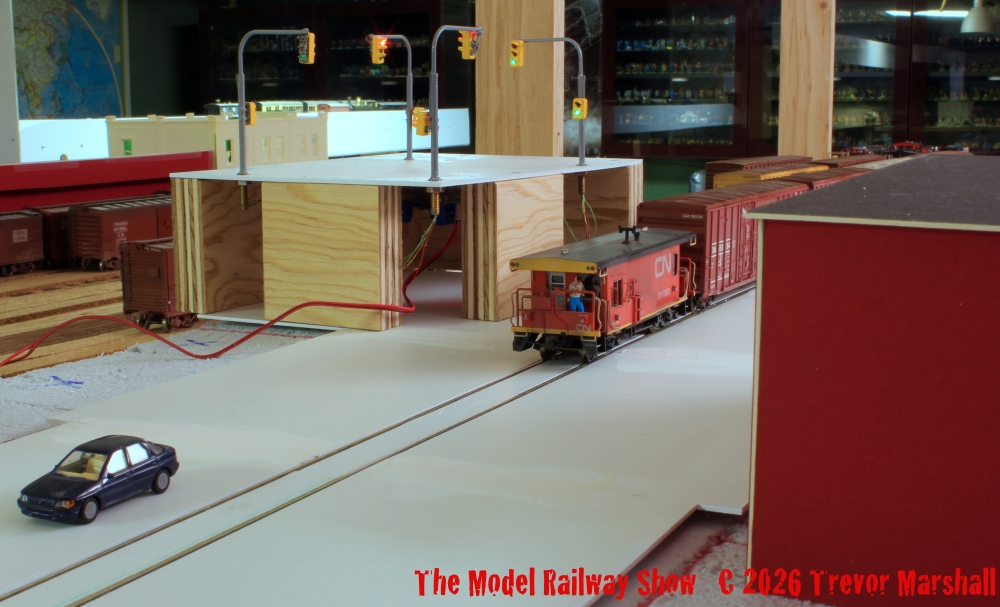
The switch job backs several blocks along Pine Street, running downgrade towards the mill. A crew member stands watch on the transfer van’s platform as the train crosses Sullivan Avenue.
Based on yesterday’s trials, I think it’s a good idea to let the engineer run the train back and forth on the first few feet of Pine Street – the in-street running section – to get a feel for the acceleration and braking.
The train continues to back north down Pine Street, which is lined with houses, small commercial buildings, parking lots, and so on. At this point, Pine Street has three driving lanes (one north, two south) plus parking lanes and sidewalks on each side.
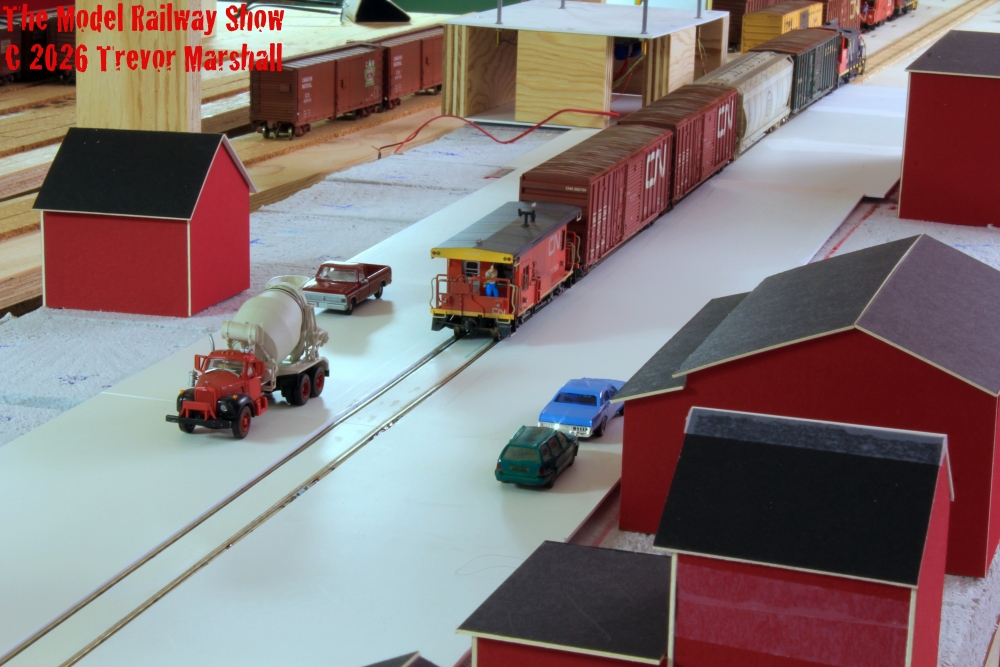
Having crossed Albert Street, the train exits Pine Street and enters the mill yard.
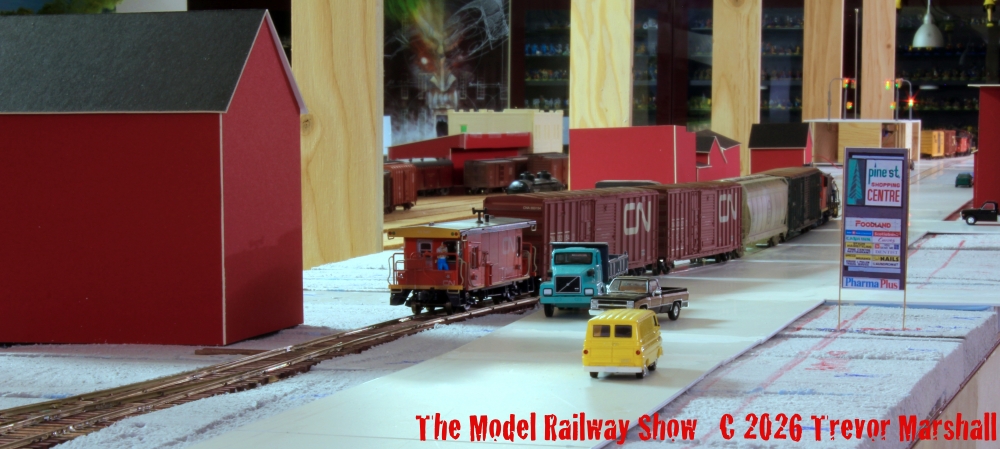
Also: You can really see the grade on Pine Street here, with the transfer van and two CNR boxcars on the level. I’m glad my friend Robin Talukdar, who laser cut the benchwork, included this feature from the prototype.
The long shove almost complete, the crew can start assessing the work to be done today. There are lots of cars on the two lower tracks (I think of them as “the bowl”) but not all of them will be lifted.
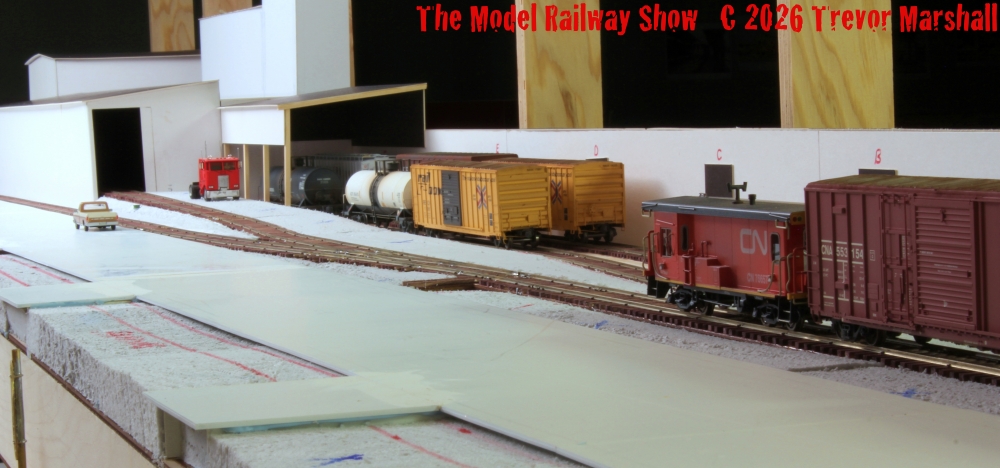
The crew starts by delivering two inbound CNR boxcars carrying loads of post-consumer waste paper. These are spotted on the “high track”, using the other inbounds as a handle so the diesel does not enter the building.
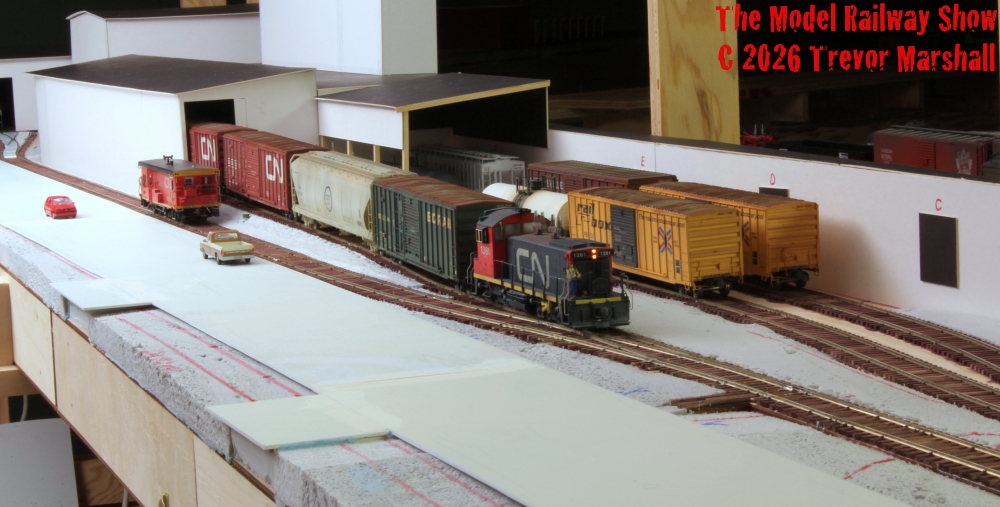
The crew then heads to the bowl to pull track 32. All three cars here are coming out. They include a covered hopper that once held caustic soda, a boxcar that delivered bagged kaolin, and a boxcar that delivered Arctic Kraft board.
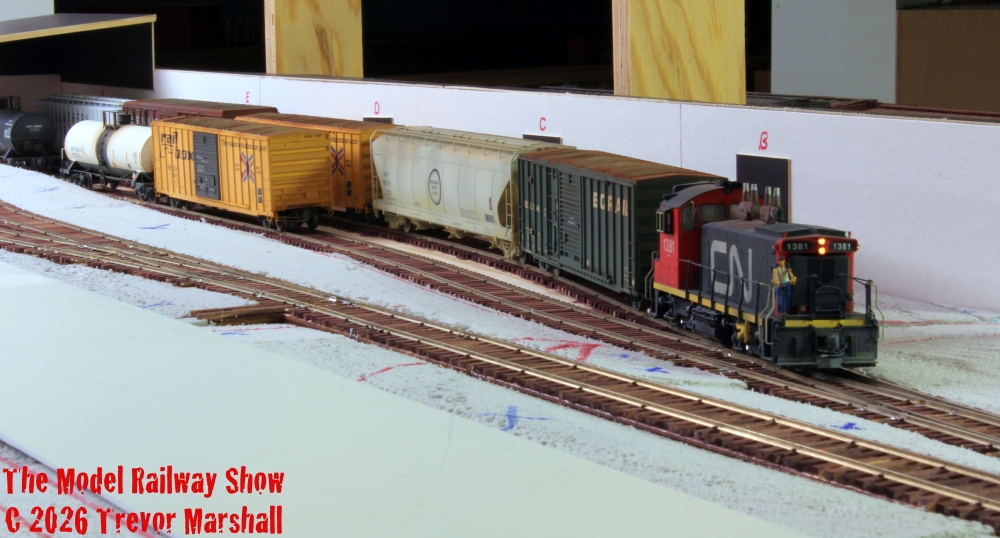
Having pulled track 32, the crew then sets in place a fresh covered hopper of caustic soda.
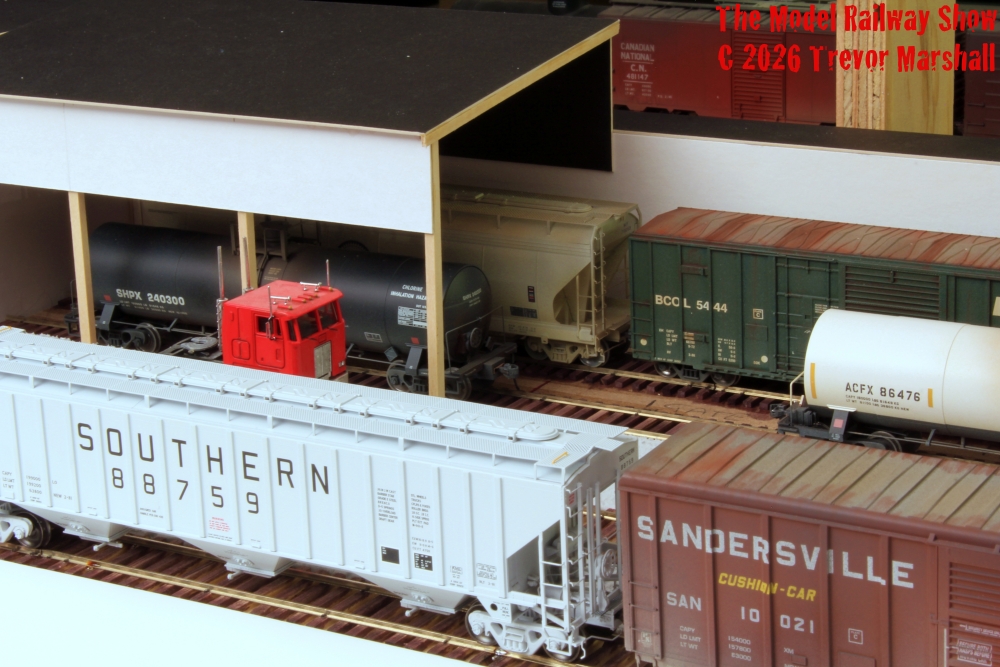
With the inbound covered hopper spotted, the next task is to swap the empty chlorine tank car for a full one, delivered on a previous day and left Off-Spot. The crew backs onto track 31 to collect the cars spotted there.
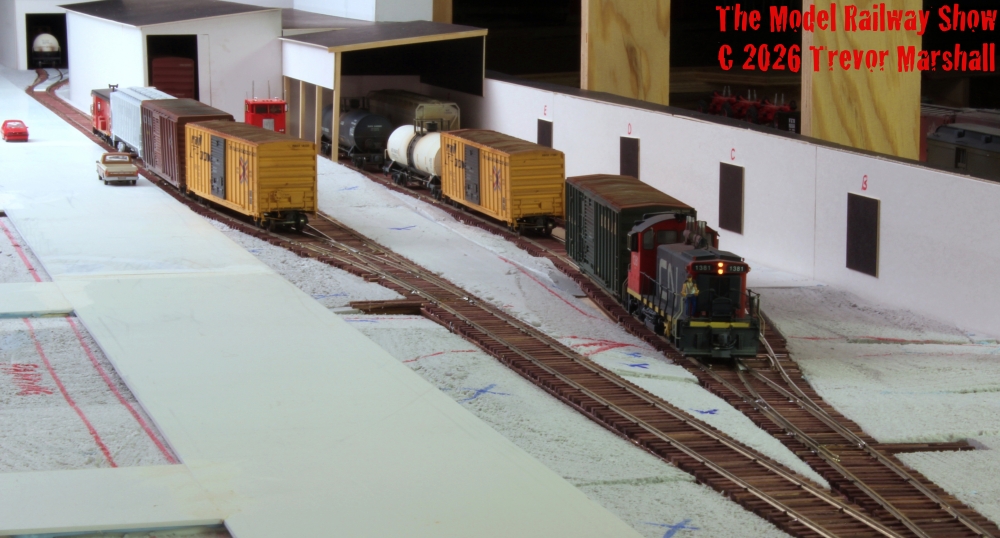
The crew is captured in the process of pulling track 31.
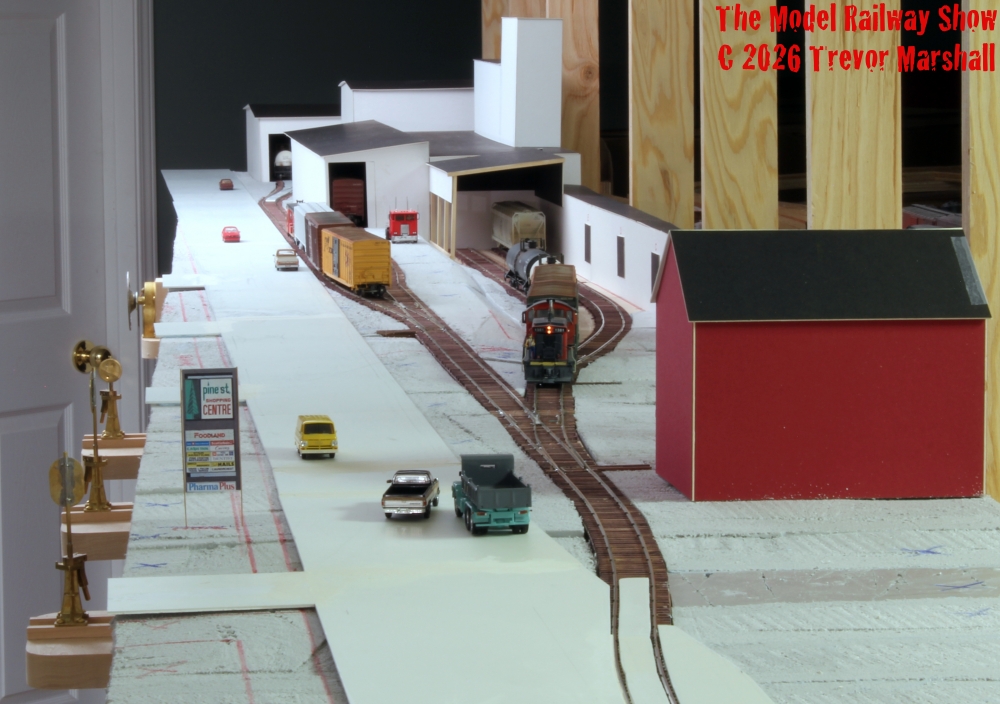
The empty chlorine tank is backed onto the outgoing train.
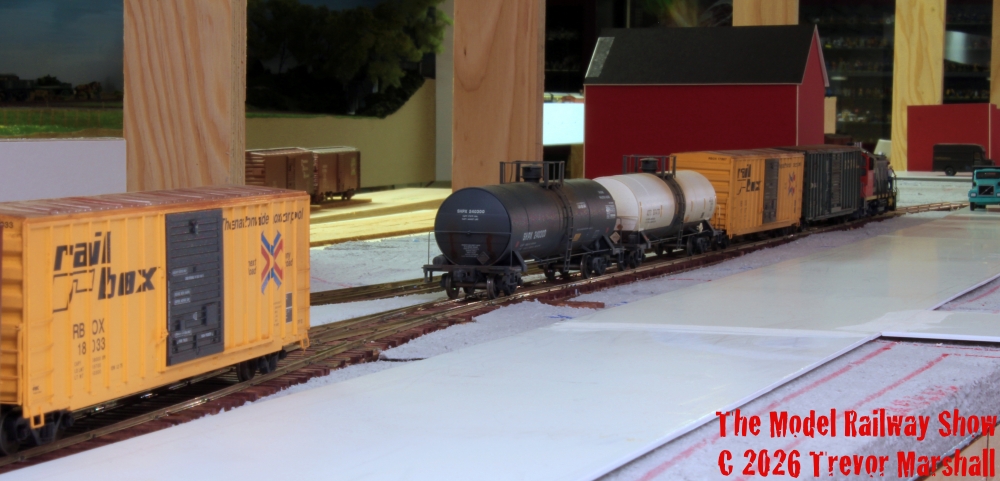
The loaded chlorine tank car is spotted under the unloading shed.
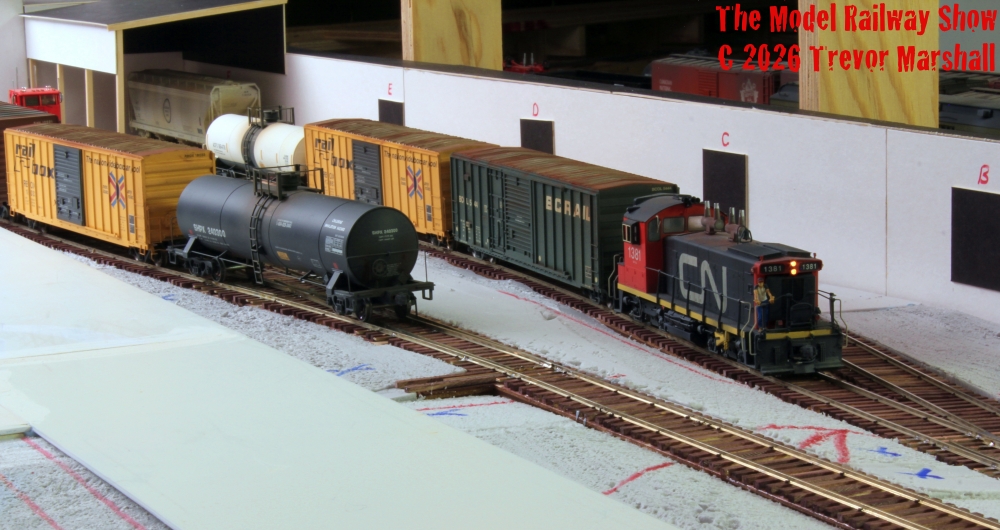
The last inbound cars – two boxcars of Arctic Kraft board – are spotted at doors D and C.
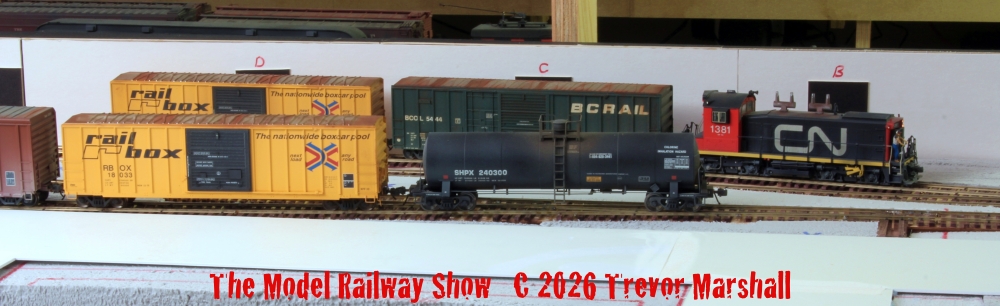
With the work done, the train is reassembled and prepares to leave the mill.
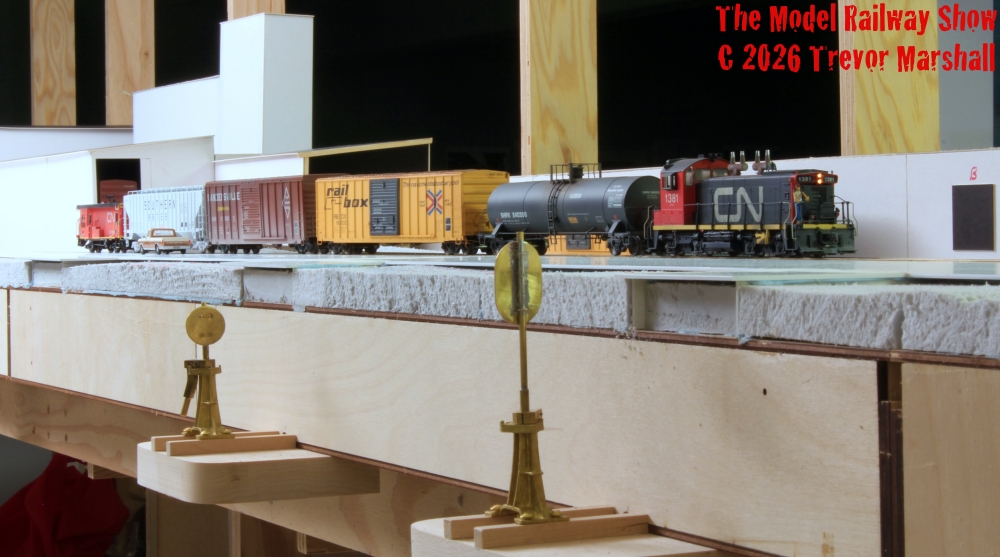
The outbound train makes its way south up Pine Street, headed for a local industry support yard. Once it has served other industries on the Fonthill Sub, this train will hit the main track and head east – tying up in the CNR’s yard in Niagara Falls.
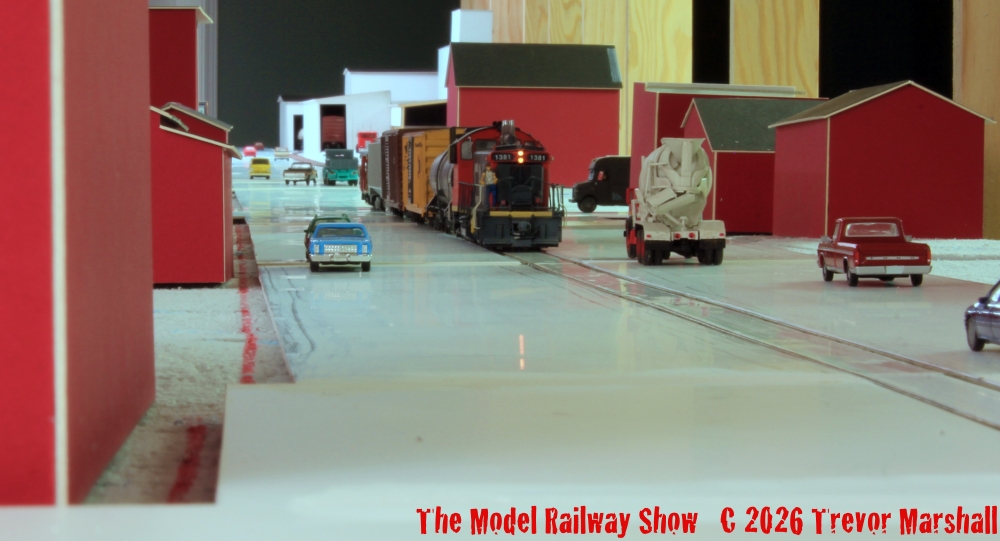
Over all, I’m thrilled with how the layout performed during its first proper test, with a guest operator (thanks again, Cal!) – and I look forward to testing it with other friends. In particular, I want to run CNR Pine Street with some friends who are newer to operations, to determine what foundational material they need in order to enjoy the experience. I have even recruited a friend who is not in the hobby at all, but wants to give it a try.
Next up, I think it’s time to add some sidewalks. Meantime, I’m still researching the structures that lined Pine Street in Thorold. And there are other layouts in my space that need some attention, too!
 The Model Railway Show