I’ve installed working traffic lights at the intersection of Pine Street and Sullivan Avenue on CNR Pine Street – my HO scale portable layout.
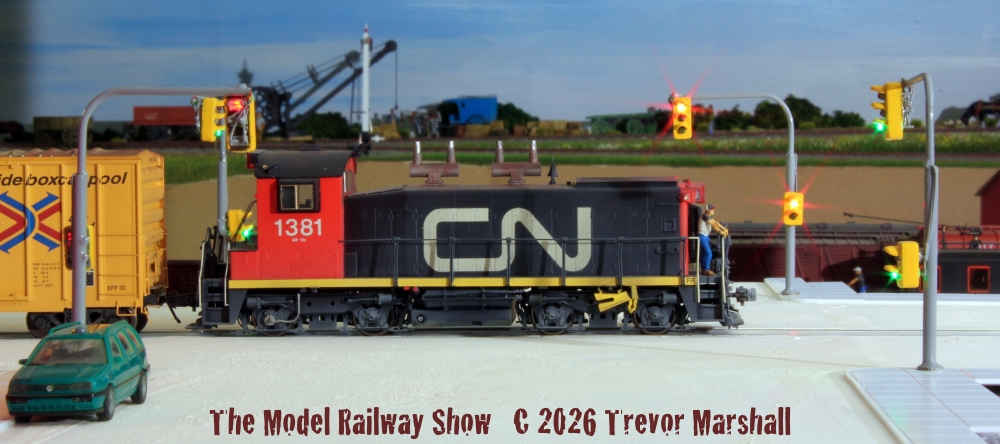
I used lights and a controller from WeHonest, a company that sells a number of LED-based lights via its eBay store. (Longtime readers may recall I bought a set almost two years ago and tested them on an intersection mock-up. I also plan to use them on my S scale layout based on the electrified Niagara St. Catharines & Toronto Railway.)
The lights include a threaded tube as their base and are meant to be mounted using a nut to secure them to one’s baseboard. But I have almost two inches of foam board between the sidewalk and the baseboard, so I needed a different solution.
I ended up drilling holes in the sidewalk – carefully, so as not to melt the styrene sheet – and down through the baseboard. I was careful to ensure these were plumb. I then glued brass tubes in place to act as conduits through the foam board scenic base.
I mounted the street lights into these tubes with some silicon caulk: It holds them in place securely, but I can break the caulk and pop out a light if I ever need to replace it.
The LED street lights are pre-wired with a simple plug on the end of each wire, designed to fit into terminal blocks on the controller board. The wires are a good length, but I still needed more length because the intersection is so large that the lights are quite spread out.
I solved this by buying some six-wire terminal blocks and fitting one below each street light. I then added longer wires to the pins on the terminal blocks.
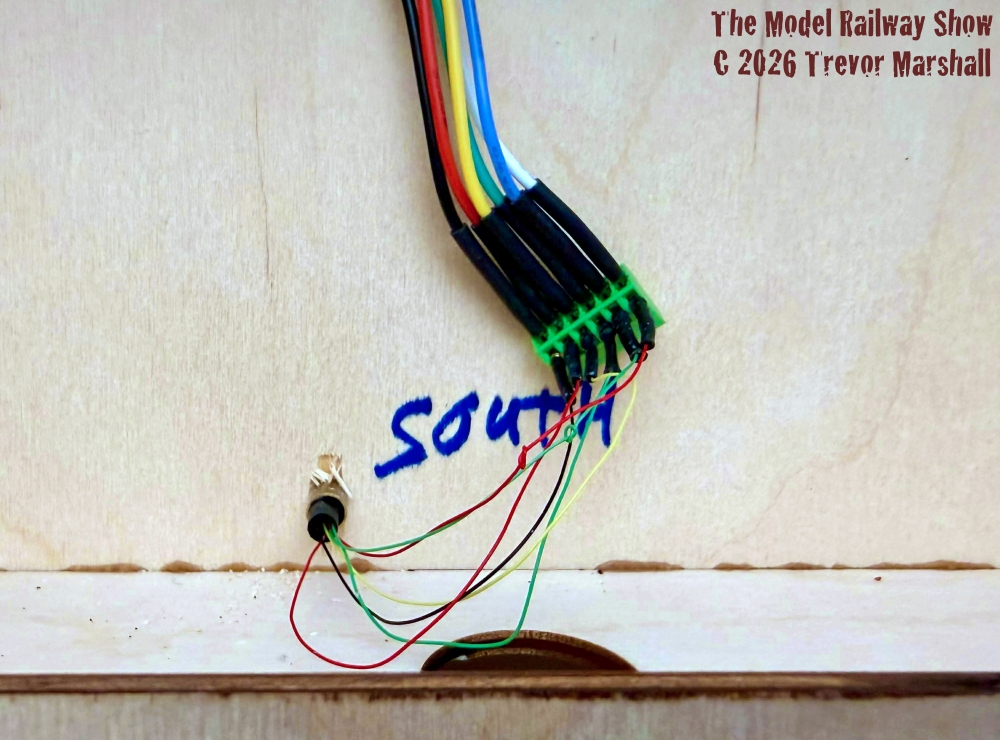
I lined each brass tube with a piece of heat shrink tubing, a little longer than the tube and glued to the brass with CA. This prevents the thin LED wires from rubbing on the lip of the brass tube, which could cause them to fail over time.
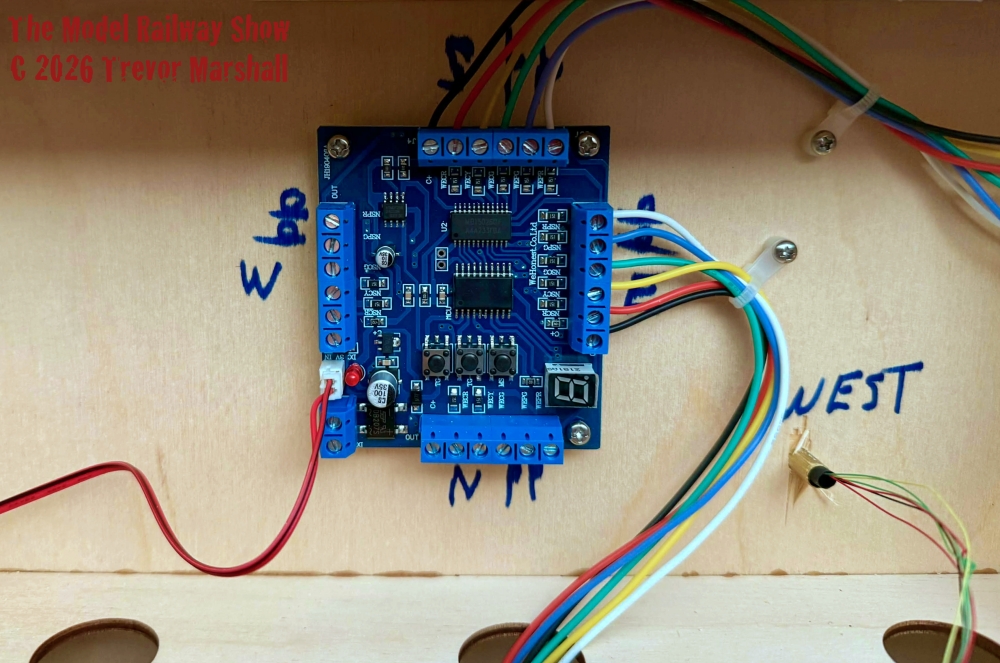
The controller is mounted on the underside of the benchwork, near the street light controlling westbound traffic. I marked the baseboard with the compass points that correspond to the controller’s outputs to I could be sure to hook the correct light to each side.
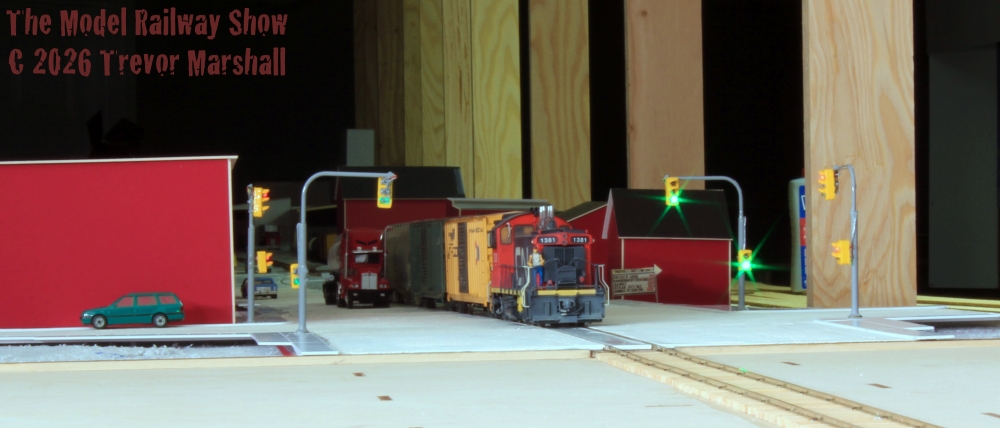
I’m generally against animated details, which are often overused and end up becoming gimmicky. But these lights add an interesting operations wrinkle: Since the track shares space with vehicle lanes, it was quite possible for a train’s progress to be blocked by cars at a red light.
I recall this situation on Welland Avenue at Geneva Street in St. Catharines – elsewhere on the CNR’s ex-NS&T lines. And my copies of NS&T employee time tables instruct all trains – passenger and freight – to obey all traffic laws, including traffic lights, when operating in streets.
I’m not sure if this remained in force after the CNR switched to diesel in 1960: I will have to find an appropriate employee time table. Regardless of the answer, I’ll likely invoke Rule 1 – “It’s my layout” – and declare the requirement still applies.
(If you have such a document in your collection – something from the 1980s, covering the Niagara Region – and are willing to look up the relevant information on the ex-NS&T lines, I’d love to hear from you: please get in touch.)
I have no plans to drive HO scale vehicles on this layout (although advances in electronics and batteries have made radio control HO scale vehicles a reality). But I’ll represent the situation in operating sessions by requiring crews to only cross Sullivan Avenue when they have a green light. Savvy operators will gauge the lights (the pedestrian lights start to flash before the vehicle lights change) and adjust their speed accordingly, so they don’t have to stop as they work upgrade from the paper plant.
In reality, Sullivan was protected by stop signs. But I could not resist upgrading the intersection, as it highlights the unique nature of running a train in the middle of a street.
 The Model Railway Show