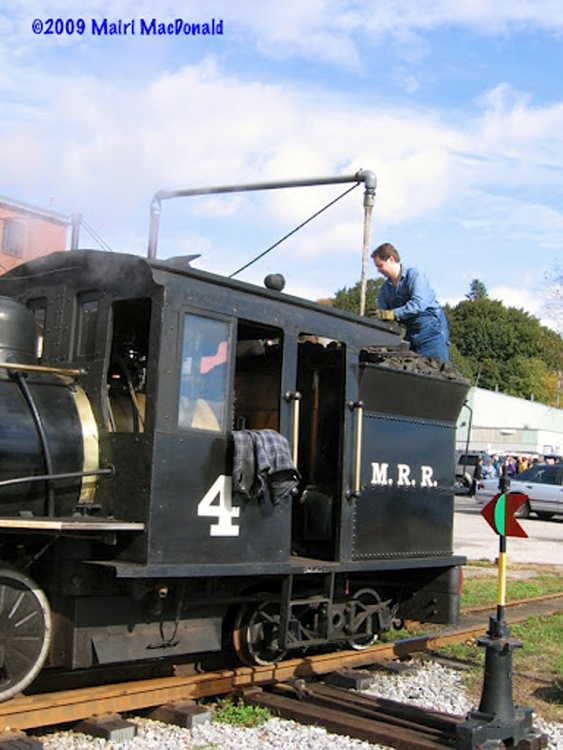
The Maine Narrow Gauge Railroad Company and Museum uses a water crane to fill the tanks on their historic steam locomotives. Here’s the story:
Back in 2006, my friend Chris Abbott and I visited the museum in December to help out with the annual pre-Christmas train rides. This is a very busy time for the museum so volunteers were most welcome.
One of our tasks was to top up the water in Monson Railroad 4. We would fill the tank every second run. The process involved one person climbing onto the locomotive, while the other passed him a fire hose, then headed into a warehouse across a parking lot to open the water valve. The person on the locomotive would drop the hose into the water in the tank so it wouldn’t thrash about while the filling proceeded. He would then have to yell at the other person to shut off the water before the tank overflowed.
The building where the valve was located had no lights, so it got quite dark at night and the valve was at the opposite side of the warehouse, so there was a lot of scrambling to turn the valve on and off. In between times, the fire hose would simply lie on the ground and drain out.
And that caused problems. Firehoses are designed to sweat, to prevent them from catching fire and when we put down the hose it would get covered in dirt. The next time we filled the tank, we’d drop the hose into the tank’s water and the dirt would come off. Eventually, the dirt clogged a filter so that one of the injectors wouldn’t work. Fortunately, the other was working and we were able to clear the filter to complete the run.
That night over dinner at J’s Oyster, we discussed the problem and by the next day over breakfast at Becky’s Diner, we had a solution: The museum needed a water crane.
When we got home, I talked to my friend Pierre Oliver about this and he agreed to help with the project. This was a great thing, since at the time Pierre worked in a theatre shop that included a fully-equipped welding bay.
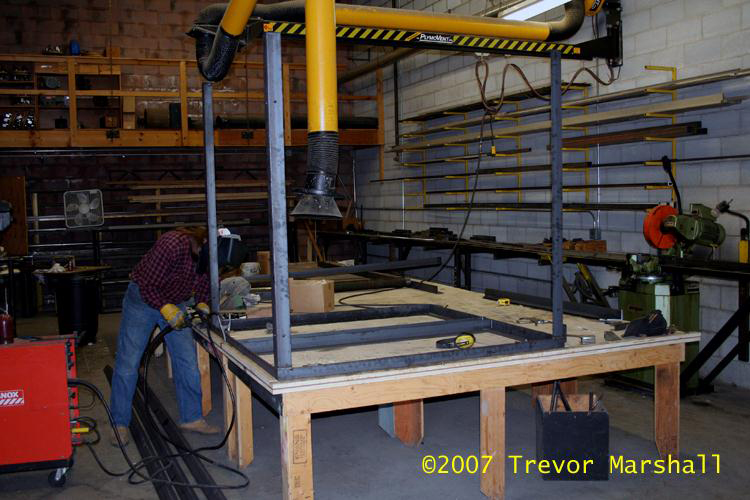
Rather than build a 100% authentic water crane, we opted for something that would be robust enough to stand up to winter in the museum’s seafront location and that could be repositioned with the museum’s front-end loader. That meant all-steel construction, although we drilled the top of the frame for wood deck boards that could be finished in a less-slippery coating.
At the bottom of the frame, we added a connection for the fire hose:
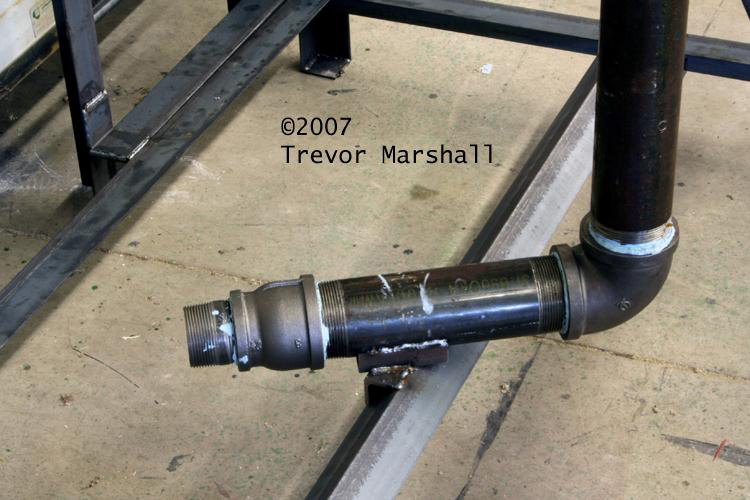
The hose would be installed before each day’s events thus keep dirt out of the locomotives. Between times, a plastic bag over the end of the water crane would keep the connection clean.
We made a ladder from angle stock, drilled for round rungs:
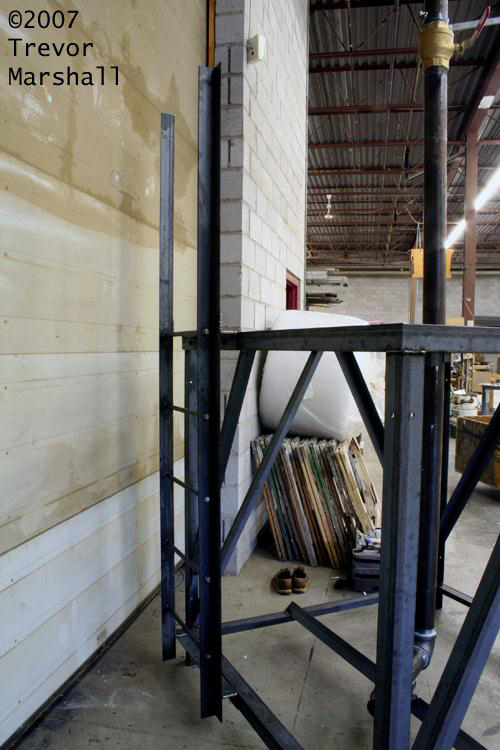
The angle stock was left long to act as hand rails when climbing to the platform.
A brass ball valve and a swivel coupling allowed the crane arm to swing over the tank, and allowed firemen to control the water locally instead of from the warehouse connection. The horizontal delivery pipe was made from PVC instead of steel to keep the weight down, and to reduce injury to equipment or people if they should bump into it.
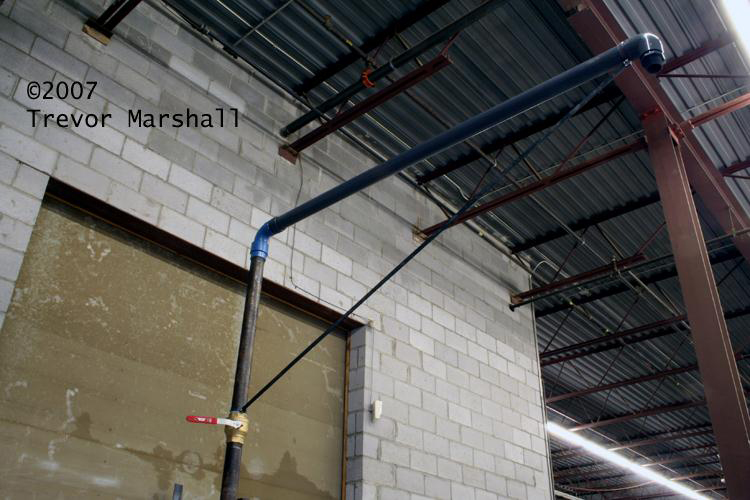
The elbow at the end of the delivery pipe was finished with a threaded section to accept a length of firehose that could be dropped into the tank of a locomotive (as seen in the lead photo).
Here’s the finished water crane, ready for pick up by a museum volunteer:
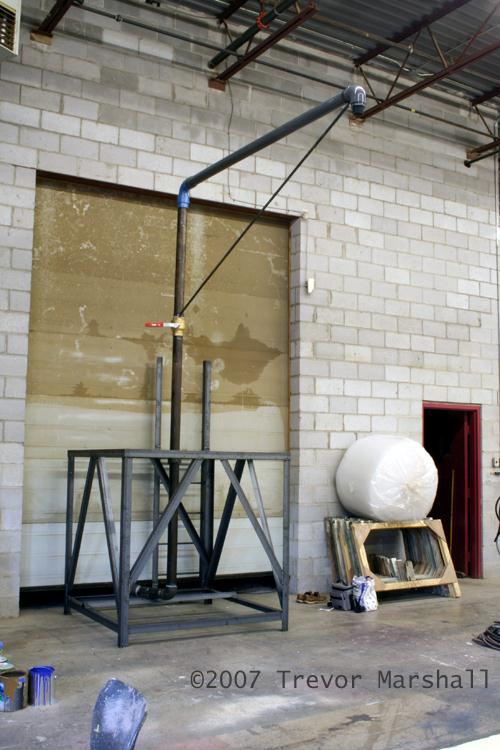
The crane is pretty tall, but was designed to come apart for transport.
This is one of the more unusual projects I’ve undertaken. It was great to be able to give something back to the museum, which had welcomed me into their steam team. It’s been a while since I’ve visited but I hope the crane continues to provide them with good service for many years to come…
 The Model Railway Show