How does one design a layout to showcase a busy stretch of street running? That was my challenge as I considered how I would transform the Canadian National Railways line along nine blocks of Ferguson Avenue into an S scale model railway.
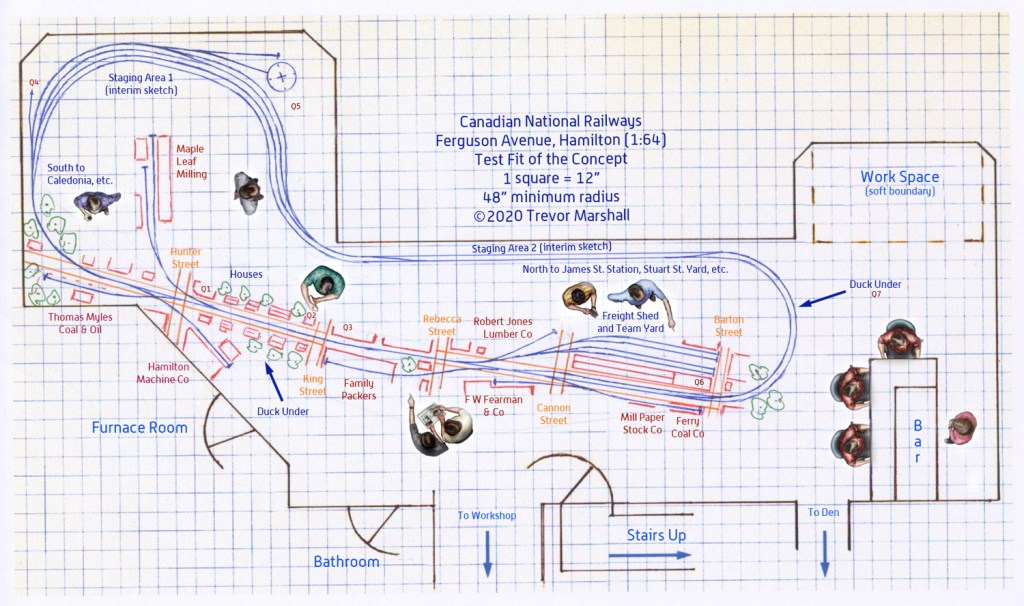
I sketched a number of possible configurations for my new space, using the templates I developed for this process. And this is the first one that I like enough to share publicly. Here’s the sketch, followed by some important notes that explain it:
First, let’s acknowledge that every modeller is different and this plan will not appeal to everyone. What I look for in a layout may not be what you desire, and vice versa. This layout is designed to achieve specific, personal goals.
Second, this is an interim plan. No – not even an interim plan: it’s a sketch. Some parts of it are very rough and subject to change, either as my thoughts develop or as I draw it to a larger scale and make decisions on what does or does not fit. Track may be added, deleted, or moved about. The same applies to structures. And trees. And so on.
What I’m doing at this point is assessing some general conditions and identifying areas for further contemplation.
Does it fit? Can I fit a reasonable representation of the prototype into my space in 1:64? Ferguson Avenue is only nine or so blocks long and my space is fairly generous. But even a small section of a real railroad is still huge, when scaled down.
Obviously, selective compression is required. Also on this point, can I incorporate suitable curves (48″ radius in S scale) into the space while still providing sufficient aisle widths to allow me, my wife, and visitors to navigate comfortably around the space.
The sketch tells me that yes, I can.
The tightest point is on the inside aisle at King Street (where the person in the green shirt is standing): That pinches down to about 30″ but quickly opens up to either side.
The corner between the two staging areas – behind the person in the green shirt – is difficult from a design perspective: the closer one gets to one of the walls, the further away the curve will end up on the adjacent wall. In the end, I found a compromise that works for me.
Can I reach? Access is critical: If you can’t reach it, you can’t maintain it. Having sketched this concept, I’m satisfied that I can reach to operate and maintain this layout if I decide to go ahead and build it.
I was particularly worried about the depth of the freight house scene. The prototype has more than twice as many tracks but I decided that by eliminating many of the spurs and compressing other elements, I could get this scene down to a reasonable width. Four spurs still give me plenty of opportunities to switch cars.
On this sketch, the freight house scene still comes out at four feet deep, but the freight shed structure occupies the centre of that depth, forcing the track closer to the aisles. Operators can reach in from both sides, and during operating sessions the crews would not have to switch sides that often: All work on the freight shed spurs would be done from inside the layout, where the two guys are standing. They can even do the transfer run from freight shed to Stuart Street Yard (staging) from there.
The deepest part of this scene – the track against the shed itself – should not require regular access during operating sessions: strings of cars can be uncoupled at the yard throat, where the reach-in access is better.
The balance of the layout is fairly skinny. Staging is not well-defined, but my plan is to build it long and thin by using crossovers to define spaces for storing trains, rather than stacking several shorter, parallel tracks to provide the capacity I would need.
Does it work? Does my plan support some semblance of the prototype operation on Ferguson? I’m pleased to report it does.
The sketch adequately represents the freight shed, even though I’ve had to reduce it to just four tracks. Those two spurs adjacent to the shed add up to something like 14 feet of track. They should accommodate 20-22 S scale 40-foot boxcars. The next pair of spurs add another 12 feet or so to a team track area for a mix of more boxcars plus gondolas, refrigerator cars, flat cars, and so on.
I’ve also managed to include a sampler of the railway’s customers along Ferguson Avenue. I have reduced Ferguson from nine blocks to five, and compressed the length of each block. I’ve also adjusted the track arrangements. The spurs along Ferguson tended to veer off at right angles to the main track. I was not able to accommodate that – it would’ve required space-eating curves and peninsulas – I’ve been able to locate the spurs far enough away from the avenue that I can still line much of Ferguson with houses and commercial buildings. And I did squeeze a peninsula in at the south (left) end of the avenue, to serve Maple Leaf Milling.
Would building this layout be satisfying yet achievable? I think it would. There are plenty of construction challenges in the form of buildings, in-street turnouts, and urban vignettes. Thanks to my previous layout (Port Rowan), I have what I need for locomotives and almost everything I would want for rolling stock: I could start operating as soon as the track is down and wired, although over time I would want to add more freight cars. There are one or two freight car types that I’d love to see produced, but none of them is a deal breaker.
My biggest hesitation about whether this layout is achievable is the number of structures required. As I’ve said many times, the layout design as presented is a sketch: I must refine it to identify which structures I can build from kits already in my possession, which structures I can build from kits that I must acquire, and which structures would require scratch-building. I must also inventory things like street furniture – mailboxes, fire hydrants, utility poles, lamp posts, signs, benches, and so on – to determine whether I can acquire or build what I would need.
Would this layout support a range of operating scenarios? Again, I think it would – from solo operations to groups of five or six people. With its continuous-run configuration, featuring a single staging yard serving both ends of Ferguson Avenue, it would even allow me to fire up a train and let it loop the layout with minimal supervision when I just want to enjoy watching something run.
Ferguson Avenue Jobs
The plan supports two local switch crew shifts. Each shift would break its time between working the freight shed and team track yard, and working the local industries. The inside track on the turn back curve to the north (right) of the shed would be used to set off cars from Stuart Street Yard for Ferguson, and to collect cars from Ferguson headed back to Stuart Street.
The shed work would include receiving cars via a transfer run from Stuart Street Yard and lining those cars up against the shed doors so they can be unloaded, sorted, and reloaded.
While the labourers at the shed do their job, the local crew would collect cars from Stuart Street and set them out at the various industries along Ferguson Avenue. They would lift any cars that the industries are done with, and collect them for forwarding to Stuart Street. This would likely be done in two trips down the Avenue, since there are spurs facing in both directions.
While I have not drawn it, the CNR and the Toronto Hamilton and Buffalo Railway had a small interchange yard to the south of Hunter Street, where cars were exchanged between the two railroads. I could include a couple of spurs in the staging area to represent this (off the switch labelled Q4), and have the local crew run cars down the avenue to exchange with the TH&B off scene.
After the cars have been worked at the freight shed, the local switch crew would have to pull these cars, then sort them into blocks to expedite forwarding before setting out the sorted cars for the transfer run to Stuart Street.
This is a busy job but also an excellent opportunity to conduct one- or two-person operations on this layout. Then there are the through trains…
The Through Trains
As I’ve noted previously on this website, every CNR train headed south of Hamilton – whether to Caledonia, Hagersville, Jarvis, Simcoe, Port Rowan or Port Dover – started its journey with a trip down Ferguson Avenue. Those trains included:
- A mixed train – M233/M238 – carrying passengers, less-than-carload-lot (LCL) freight, and express to all stations between Hamilton and the two ports, plus the occasional carloads of freight to Port Rowan and/or Port Dover.
- The Simcoe Way Freight, which ran Hamilton to Simcoe and return. This train’s primary job was to switch the giant American Can Company plant in Simcoe, plus Aylmer Canners, the Norfolk Fruit Growers, and a number of smaller rail-served customers in the community.
- The Jarvis Turn, which ran Hamilton to Caledonia with trips to Jarvis when required. The main task for this train was to serve the Canada Gypsum Lime and Alabastine Company in Caledonia.
- The Day Hagersville and Night Hagersville: These two trains worked Hamilton to Hagersville and return, primarily to haul stone from three quarries around Hagersville – Halidmand Quarries, Canada Crushed Stone, and Hagersville Quarries.
On the concept sketch, each of these trains would start at Hamilton (staging) and make a southbound run (clockwise around the layout) to end up back in staging. Here, the staging yard operator would pull the locomotive and turn it on the turntable provided, then prepare the train for its return trip north (counterclockwise around the layout) to Hamilton. This might involve adding loads to gondolas or hoppers in stone service, swapping out cuts of freight cars to give the northbound train a different look, and moving the van (caboose) to the opposite end of the train.
(Using a single staging area to represent both ends of the line means I can re-use freight cars on several trains. This is a huge consideration in S scale, which does not have the firehose of product that one finds in HO. I’m not interested in building and maintaining two staging areas and doubling, tripling, or even quadrupling my freight car fleet just to have most of it spend most of the time sitting idle in staging yards.)
All told, this schedule adds five round-trips – 10 trains – to Ferguson Avenue each day. Then there are the helpers…
Climbing The Mountain
Just south of Ferguson Avenue, the railway encountered the Niagara Escarpment – a 90-metre (295-foot) climb out of the Lake Ontario basin. With only a few passenger cars in the consist, the Mixed Train M233 was able to manage this obstacle without assistance. But the freight trains required some extra muscle.
That muscle came in the form of a crew working in helper service. The crew would command a much larger engine – typically, a 2-8-2 – that would be added to southbound freights at Stuart Street Yard. Because these freight trains all operated as extras, and because extras are identified by the number on the lead locomotive, the helper engine would be added behind the road engine.
Somewhere at the top of the Niagara Escarpment – typically at Rymal or Glanford, but sometimes at Caledonia – the train would stop and the helper engine would be cut out and run into a siding. Once the train continued its journey south, the helper crew would run tender-first back down the mountain and along Ferguson Avenue to Stuart Street to await its next assignment.
On the concept sketch, the use of a single staging area means I’m able to model the helper operation without having to model the climb itself. (It’s a personal perference, but I’m not a fan of grades – especially when combined with steam locomotives.)
The light helper movements add a further four “trains” northbound on Ferguson each day.
Crewing Options
For an operating session, I see several options:
- One- or two-person operation: Switching the Ferguson Avenue Freight Shed and/or the local railway customers along the Avenue.
- Three-person operation: add a staging yard operator who would prepare blocks of cars for the Freight Shed and the Avenue, and would also operate transfer runs from Stuart Street Yard to the north end of Ferguson Avenue. If this operator had time, they could also run through trains and helpers.
- Four-person operation: split the staging yard operator’s role, with one person responsible for train preparation and the other responsible for running the through trains, helpers, and transfer runs.
- Five-person operation: split the through-train operator’s role, with the fifth person taking on helper crew duties.
I have included a number of notes on the concept sketch that require some explanation.
First, the staging yards are both labelled “interim sketch”. The scale of this drawing – one square to 12″, and reduced to print on a single page – means the squares work out to approximately 3/16″ when printed. That’s too small to reliably draw parallel tracks at proper spacing.
Instead, my goal here was to assign space in the room to staging – for example, a curved yard with a minimum radius of 48″ in the Staging Area 1 space, and a shelf roughly 15″ deep along the Staging Area 2 space. I’ll work out the details later.
I did suggest some trackage, based on the need for space to store one short passenger train, 3-4 decent-sized freights, and a cut of cars feeding from Stuart Street to the north end of Ferguson Avenue. But they are only suggestions at this point. I will think in more detail about the staging requirements and plan accordingly. I expect more tracks will be added to both locations.
I have taken liberties with the arrangement of cross streets along Ferguson Avenue. For example, at the intersection of Ferguson and King, I have the private right of way extending to the north of King Street. It should be to the south. I would model the buildings at this intersection so that they’re in the correct relationship to the street and private right of way, which means rotating the entire intersection 180 degrees from reality. The buildings labelled Q2 and Q3 appear in many photographs so putting them in the right relationship with the T-intersection is more important that putting them on the proper corner. As long as it looks right in photographs, I can live with that.
In a similar vein, there’s a well-known building (Alexanian Carpet Cleaners) at the corner of Ferguson and Rebecca. But I can’t fit it there on my plan. I may move it to Hunter Street (labelled as Q1). The spur curves the wrong direction in front of it there. I need to decide if I’m happy with that.
I have not drawn the TH&B interchange, but the tracks for that could go in the space in the upper left corner of Staging Area 1 (labelled Q4).
I have not thought about storage tracks for extra locomotives, non-revenue equipment, and other pieces. There’s plenty of space (labelled Q5) near the turntable in staging.
The crossover at Ferguson and Barton (Q6) is backwards on this plan, but fits better into the curve this way. It would mean keeping the inside track on the curve clear near the crossover so the switch crew could use the runaround in Ferguson Avenue to set up cars for switching the local customers. Since that inside track is also used to exchange cars with the Stuart Street transfer run, I should consider flipping the crossover to its proper orientation.
I’ve labelled the turnback curve between Ferguson and Staging Area 2 as a duck under (Q7). I would build the layout fairly high, while also respecting the need to reach-in to the freight shed scene to couple, uncouple, and (hopefully not too often) re-rail equipment. I should consider whether this curve can incorporate a swing-out gate instead of a duck-under.
Finally, I had real challenges envisioning a layout in my new space until I added some people to my sketches to give me a proper sense of scale. For these, I used PhotoShop to lift some “operators” from layout plans drawn for Model Railroader magazine, then used the grids from the MR plans to rescale the people to match the grid on my sketch. If you’re having similar challenges, try adding people to your drawings.
My next step is to draw the space to a larger scale, then refine the plan. I’ll add benchwork edges, double-check reach-in distances, and further develop the staging areas.
(I’m indebted to two sources for prototype information. These are “Hamilton’s Other Railway” by Charles Cooper and “Steam Echoes of Hamilton” by Ian Wilson. Both are excellent books and I’m grateful the authors wrote them.)
As a bonus, I think I can use at least some of the space over or under the staging areas to build a shelf layout or two that will allow me to operate and enjoy some of the models I have in different scales.
All in all, I’m pleased with my progress. While I am not yet ready to say “This is the way”, it’s very promising indeed.
 The Model Railway Show