My post about my first sketch for a model railway based on Ferguson Avenue in Hamilton generated a fair bit of feedback about duck-unders. I’d like to thank everyone for the thoughts, and provide a few thoughts of my own.
My layout sketch includes two duck-unders, highlighted here:
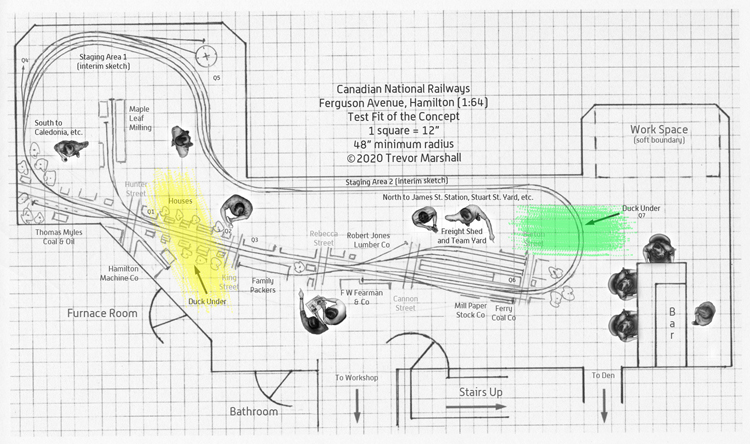
I envision operators using the green duck-under most frequently. I’ve added the yellow one primarily as a means of quick/alternate exit from a long aisle in case of emergency, but it’s also an optional shortcut for the more nimble. So let’s set that one aside and focus on the green one.
First, I’ll admit I hate duck-unders. I’d rather not have one. Unfortunately, if I want to model Ferguson Avenue in S scale in this layout space a duck-under is pretty much unavoidable. The continuous-run nature of the plan dictates that at some point, one is going to have to get inside the big, closed loop.
That said, I’ve built layouts with duck-unders before, and there are a number of factors to consider. These include:
- How often will the duck-under be used in an operating session?
- How high will the benchwork be?
- How deep is the span being ducked under? (In other words, how long do you have to duck before you can stand up again?)
- How wide is the opening? (In other words, do you have to enter the duck-under head-on and waddle to the other side, or can you stand sideways and then swing your torso under it?)
- How is the duck-under finished? This includes the shape, the materials, any protective padding, and so on.
- Does the duck-under include aids such as handrails or a chair on casters?
These are all things I would consider if I build this layout.
On a previous layout, I incorporated a duck-under to reach a staging area and I finished the opening with masonite panels on all sides. I used glue on the masonite panels – I was careful to not include anything such as screw heads that might catch clothing – and I finished the duck-under entrance at both ends by curving the edges to remove any sharp corners. It worked well – one could actually slide one’s back along the duck-under while getting from one side to the other.
Admittedly, I was much younger than I am now. That said, it was also much lower than what I envision for Ferguson Avenue. The span was much deeper too.
While I have not drawn benchwork edges on my Ferguson Avenue sketch, I would make the green duck-under as shallow as possible – ideally, not much deeper than the double-track roadbed. I would brace this span like a through girder bridge, with benchwork framing above the track’s subroadbed to maximize the clearance height while providing the rigidity such a span would require.
I will also consider whether a swing-out gate is a better option. My friend Richard Chrysler had a beautiful gate to enter his layout:
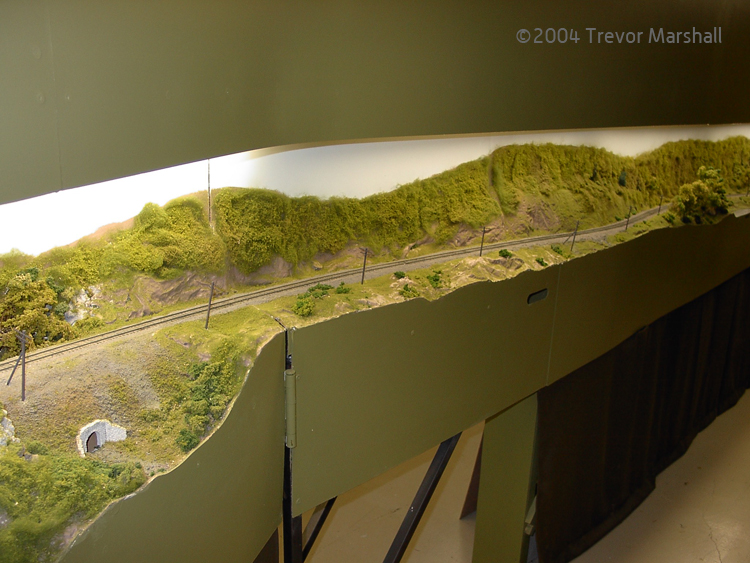
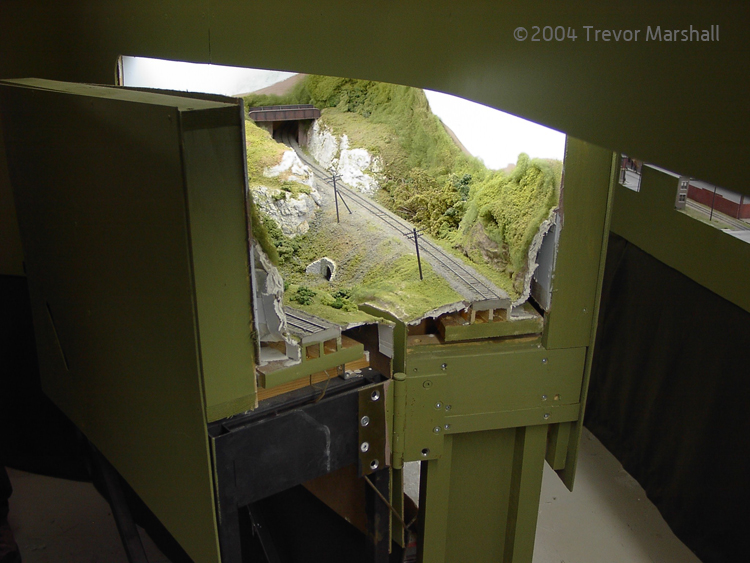
Rich’s gate featured a steel frame, welded up by a mutual friend of ours. (I won’t name him here, because he probably doesn’t want to go into the business of building swing gates for others.) It was very reliable because the steel frame did not move with seasonal changes in temperature or humidity.
That said, I do have two things to consider about such a gate.
- First, there’s the issue of anchoring the two pieces of benchwork to either side of the opening to ensure they maintain proper alignment. I have a fully-carpeted layout space and I’m not about to drill through it into the floor to anchor the benchwork. The alternative is to connect the two sides of the opening, either with a step-over at floor level, an arch overhead, or both.
- Second, there’s the issue of the inner track on the turn back curve. This is used as the transfer track between the Stuart Street Yard and the switch crew working the Ferguson Avenue freight shed and local customers. I would not want to open this swing gate if there are cars standing on this track: That would be a recipe for disaster.
I hope this post eases the concerns of those who commented about duck-unders on the initial sketch. Rest assured if I can’t resolve this to my satisfaction, I will consign Ferguson Avenue to the “interesting thought experiment” bin and plan something else…

